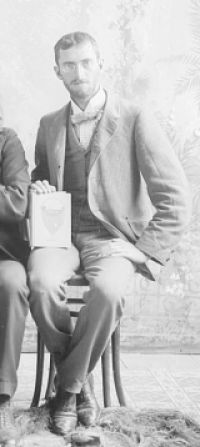
George Parker Winship

George Parker Winship

Summary

Portrait of George Parker Winship George Parker Winship Luther S. Livingston, 1864–1914 (1915)

Livingston's remarkable memory for minute details and his ability to recognize peculiarities in volumes with which he was unfamiliar had long been an important asset which did much to give the house its preëminent position among American dealers in rare old books. These qualities combined with the instinctive confidence which every one who dealt with him felt in his frankness and sincerity, gave the new firm an unassailable position.
Source: Wikisource

Portrait of George Parker Winship George Parker Winship Luther S. Livingston, 1864–1914 (1915)

Livingston never liked city ways, and in 1888 he took up a plot of government land at Melbourne, near the head of navigation on the St. John's River in Florida. The inspiration for this venture came from the books of Thoreau. He was ambitious to emulate the simple life as expounded by the Concord seer. Unluckily the Florida glades concealed no motherly neighbours from whose pantry shelves pockets could be stuffed with doughnuts, and the life proved too simple. After a year of unremunerative grubbing at palmetto roots, Livingston returned to the New York bookstore.
Source: Wikisource

Portrait of George Parker Winship George Parker Winship Luther S. Livingston, 1864–1914 (1915)

The wonder in Livingston's own mind, during the last few months, was that the chance for a wider fame and a more eminent position in the world of scholars, had come to him, a book seller's clerk who had never entered college.
In 1898 he married Flora V. Milner of Deer Lodge, Montana, a friend of his boyhood. Mr. and Mrs. Livingston made their home at Scarsdale, nineteen miles north of New York City. There he found three acres of woods, cliffs, swamp and proper soil for the garden into which he put the happiest part of every week.
Source: Wikisource

Get perspective with Kwize: daily news enlightened by great literature