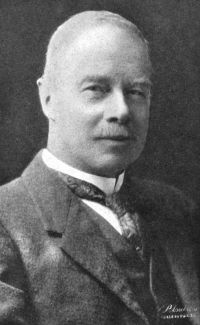
George Vernon Hudson

George Vernon Hudson

Summary

Portrait of George Vernon Hudson George Vernon Hudson New Zealand Moths and Butterflies… (1898)

At night the larvæ may be seen busily engaged: they project the head and first four segments of the body beyond the case, and walk about with considerable rapidity, often lowering themselves by means of silken threads; the only locomotive organs are, of course, their strong thoracic legs, which appear to easily fulfil their double function of moving both larva and case. If disturbed, these insects at once retreat into their cases, closing the anterior aperture with a silken cord, which is kept in readiness for the purpose, and pulled from the inside by the retreating larva.
Source: Wikisource

Portrait of George Vernon Hudson George Vernon Hudson New Zealand Moths and Butterflies… (1898)

The remaining segments are considerably thickened near the middle of the insect, rudimentary prolegs being present on the seventh, eighth, ninth, and tenth segments of the larva. The anal prolegs are very strong, and are furnished with numerous sharp hooklets, which retain the larva very firmly in its case. As the caterpillar grows, it increases the length of its domicile from the anterior, causing it gradually to assume a more tubular form, tapering towards the posterior aperture, which is enlarged from time to time.
Source: Wikisource

Get perspective with Kwize: daily news enlightened by great literature