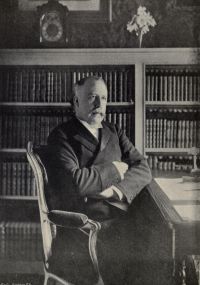
George William Erskine Russell

George William Erskine Russell

Summary

Portrait of George William Erskine Russell George William Erskine Russell Fifteen Chapters of Autobiography

One emerged (like Herbert Gladstone) from the obscurity of College rooms or from the undistinguished herd of London ball-goers, or from the stables and stubbles of a country home, and became, all in a moment, a Personage. For the first time in one's life one found that people—grown-up, sensible, vote-possessing people—wished to know one's opinions, and gave heed to one's words. For the first time, one had "Colours" of one's own, as if one were a Regiment or a University; for the first time one beheld one's portrait, flattering though perhaps mud-bespattered, on every wall.
Source: Gutenberg

Portrait of George William Erskine Russell George William Erskine Russell Fifteen Chapters of Autobiography

He had conciliated the House of Lords, which in old days had looked askance at the picturesque adventurer. He was supported by a strong, compact, and determined majority in the House of Commons. He was the idol of Society, of the Clubs, and of the London Press. He was, in short, as nearly a dictator as the forms of our constitution permit; and the genius, which for forty years had been hampered and trammelled by the exigencies of a precarious struggle, could now for the first time display its true character and significance.
Source: Gutenberg

Portrait of George William Erskine Russell George William Erskine Russell Fifteen Chapters of Autobiography

The mention of Matthew Arnold reminds me that, though I had admired and liked him in a reverent sort of way, when I was a Harrow boy and he was a man, I found him even more fascinating when I met him on the more even terms of social life in London. He was indeed the most delightful of companions; a man of the world entirely free from worldliness, and a man of letters without the faintest trace of pedantry.
Source: Gutenberg

Get perspective with Kwize: daily news enlightened by great literature