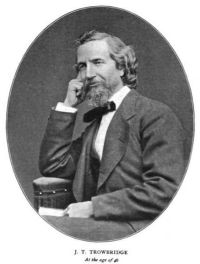
“ The poet—and whether he had slumbered or not nobody but himself is qualified to judge—the poet pensively opened one eye and peeped at Harrow as that young man bent beside him with Lethbridge at his elbow.“In sending those two tickets you have taught us a new creed,” whispered Harrow; “you have taught us innocence and simplicity—you have taught us to be ourselves, to scorn convention, to say and do what we believe. ”
Harrow
Definition and stakes
The concept of "harrow" encompasses both a farming tool and a symbol of institutional strictness, examined by authors in a wide range of contexts. From Robert W. Chambers’ poetic reflection on Harrow as a catalyst for self-expression to Gervase Markham’s practical account of its agricultural function, the theme connects physical toil with intellectual or emotional growth.
Writers like Harry How and Douglas Brooke Wheelton Sladen emphasize its role in education and personal development, while others, such as Maurice Hewlett, invest it with metaphysical depth. These differing viewpoints reveal harrow as a multifaceted motif, linking the concrete and the abstract.
Quotes about “harrow”
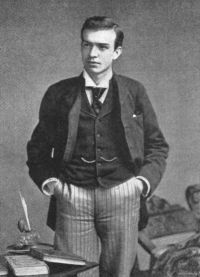 Harry How,
The Strand Magazine
(1892)
Harry How,
The Strand Magazine
(1892)
“ A certain well-known head master of Harrow used to say to a boy after he had birched him, 'I forgive you!' and he accompanied every stroke on the delinquent's body with such expressions as 'Now, be a man!' 'Be brave!' 'I'm so sorry!' And he meant it. The reason for his taking to birching the boys was an amusing one. He was humanity itself, and he got another master to do the thrashing. ”
The Muse in Arms (1917)
“ They showed the way to more, their names will ring Through all succeeding years of Harrow's fame, Whatever changes after years may bring Their sons will follow up and play the game. O Mother Herga, all our thanks we give For all your care of us, your watchful eye: You made us men, you taught us how to live, And in your wisdom taught us how to die. The strongest bond of all, the bond of friends Made in our youth, a bond that naught can break, Binds us to you until our journey ends, We live, we fight, we die for Harrow's sake. ”
Various, Harper's New Monthly Magazine, No…
“ There was crowding on the funeral day beside the road that led to Lady Tempest's. People came trooping from far and near, with a company of boys belonging to Harrow School, thoughtless, and amused with the strangeness of a spectacle which might rather have excited feelings of sorrow and commiseration. ”
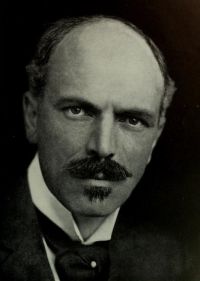 Maurice Hewlett,
Rest Harrow: A Comedy of Resolution
Maurice Hewlett,
Rest Harrow: A Comedy of Resolution
“ Like Dante, vo significando: I am a drain-pipe for her spirit. She was Hymnia to me once, and I sang of Open Country; now she is Despoina, Mistress of the Night. Words come thronging to me, phrases, rhythms; but not Form. I shall get out a poem one of these days—when the harrow rests. And that will be its name: Rest Harrow.” He broke out after a pause-“Her beauty! What is it to the purpose to put its semblance into words? Its significance is the heart of the matter. We see the earth as hill and valley, pasture and cloud, sky and sea. Really it is nothing of the kind, but infinitely more. ”
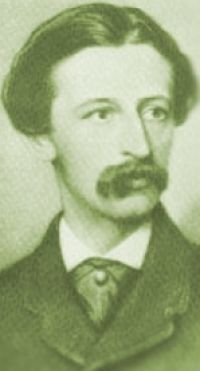 Augustus John Cuthbert Hare,
The Story of My Life — Chapter IV: Lyncombe
(1890s)
Augustus John Cuthbert Hare,
The Story of My Life — Chapter IV: Lyncombe
(1890s)
“ As I was drawing the village, a farmer came riding by, and, after looking at my sketch, went back with me to show me his house, once a manor of the Hungerfords, with a splendid old carved chimney-piece.“These are very long dreary half-years. At Harrow I used to rejoice that I should never more have to endure those horrible long private-school half-years, yet here they are again. Oh! what would I not give to be back with you, and able to take care of you when you are poorly!” ”
Various, The Atlantic Monthly, Volume 17…
“ He was in the army, and because he objected to some of Harrow's doin's, Harrow had him arrested, and treated him very much amiss. That ground into his conscience and feelin's, and he deserted fo' no other puppose than to shoot him. ”
 Douglas Brooke Wheelton Sladen,
Twenty Years of My Life
Douglas Brooke Wheelton Sladen,
Twenty Years of My Life
“ He started with Harrow and the Rifle Brigade, and had been many things, from a rancher in California to an artist, before he found his vocation in literature. The Hill, his famous Harrow school novel, increased his popularity wonderfully, but he was an admirable writer from the first, both in story and style. I have heard it stated that on one of his great books his publishers made the sporting suggestion that he should receive no advance on account of royalties, but a thirty per cent. ”
“ There are some men, Harrow, who find rest simply in changing the brain's occupation.""Yes, sir, quite so," admitted the butler dubiously. "Still, as the poet says, sir, it's sleep that 'knits up the ravelled sleeve of care,' sir. Sometimes I have apprehensions that the master will overtax his strength.""I didn't know, Harrow," smiled the secretary, "that you were a disciple of the poets." ”
 Gervase Markham,
The English Husbandman
Gervase Markham,
The English Husbandman
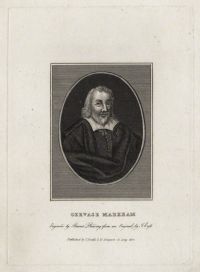
“ Now for the vse of Harrowes. The woodden Harrow which is the Harrow with woodden téeth, is euer to be vsed vpon clay grounds and light grounds, which through drynesse doth grow loose, and fals to mould of it owne nature, as most commonly Sand grounds doe also: and the Iron Harrow which is the Harrow with Iron téeth, is euer to be vsed vpon binding grounds, such as through drynesse grow so hard that they will not be sundered, and through wet turne soone to mire and loose durt. ”
 Mark Twain,
Adventures of Huckleberry Finn…
Mark Twain,
Adventures of Huckleberry Finn…
“ Is a HARROW catching—in the dark? If you don't hitch on to one tooth, you're bound to on another, ain't you? And you can't get away with that tooth without fetching the whole harrow along, can you? Well, these kind of mumps is a kind of a harrow, as you may say—and it ain't no slouch of a harrow, nuther, you come to get it hitched on good. ”
George Walter Fiske, The Challenge of the Country: A Study of Country Life Opportunity
“ Likewise the harrow, so simple in our grandfathers’ days, has remarkably developed, and we have peg-tooth, spring-tooth, disk, spader and pulverizer harrows, drawn by horses or mules, which follow the plow with a four- to twenty-foot swath. ”
 Augustus J. C. Hare,
The Story of My Life, volumes 1-3
Augustus J. C. Hare,
The Story of My Life, volumes 1-3
“ At Easter, 1848, I left Harrow for the holidays, little imagining that I should never return there. I should have been very sorry had I known it. On the whole, the pleasurable "adventures" of a public-school life had always outweighed its disagreeables; though I was never in strong enough health for any real benefit or enjoyment.IV LYNCOMBE"Les longues maladies usent la douleur, et les longues espérances usent la joie."—Mme. ”
Anthony Florian Madinger Willich, Domestic Encyclopædia (1802)
“ Harriott's road-harrow is drawn by two horses abreast: the outside animal is led by a boy on that quarter; while the other horse walks in the proper path, and a man keeps the harrow steady by the handles ”
 John Stephen Farmer,
The Public School Word-book
John Stephen Farmer,
The Public School Word-book
“ He goes out with his umbrella rolled up, and he finds he is swaggering; or he carries it by its middle, or under his arm, or he walks on the middle terrace after chapel, or he innocently wears his “blues” open when it is hot, or turns his trousers up when it is wet, and again he is swaggering. Lady visitors sometimes think small boys at Harrow rude. It is not rudeness which leads boys to stick close to the wall, even when coming up covered with mud from football, and shoulder the world into the gutter, it is modesty ”
Catherine Sinclair, Modern Flirtations: A Novel
“ Between High and Low Harrowgate, besides a broad, circuitous high-road, two pleasant rural paths lead through the fields, on which a gaily-dressed crowd may be seen from peep of day in the morning, hurrying along in rapid succession to the well, with looks of anticipated disgust in the prospect of that strange compound of horrors which they are about to swallow, only comparable to the washings of an old gun-barrel. ”
Catherine Sinclair, Modern Flirtations: A Novel
“ High Harrowgate, where the more aristocratic strangers and invalids annually resort, is nearly two miles distant from the mineral well, and from Low Harrowgate, which is infested by the more inveterate class of water drinkers. ”
 Thomas Hardy,
Moments of Vision and Miscellaneous Verses
Thomas Hardy,
Moments of Vision and Miscellaneous Verses
“ Only a man harrowing clods In a slow silent walk With an old horse that stumbles and nods Half asleep as they stalk.IIOnly thin smoke without flame From the heaps of couch-grass; Yet this will go onward the same Though Dynasties pass.IIIYonder a maid and her wight Come whispering by: War’s annals will cloud into night Ere their story die. ”
“ But on the morrow, when the time grew near, the king's daughter and this hero of arms went to give a meeting to the beast, and they reached the black rock, at the upper end of the loch. They were but a short time there when the beast stirred in the midst of the loch; but when the General saw this terror of a beast with three heads, he took fright, and he slunk away, and he hid himself. And the king's daughter was under fear and under trembling, with no one at all to save her. Suddenly she sees a doughty handsome youth, riding a black horse, and coming where she was. ”
Charles Hardwick, Traditions, Superstitions and Folk-lore
“ The trader in horses followed his guide in the deepest astonishment through several long ranges of stalls, in each of which a horse stood motionless, while an armed warrior lay equally still at the charger's feet. 'All these men,' said the wizard in a whisper, 'will awaken at the battle of Sheriffmoor.' At the extremity of this extraordinary depôt hung a sword and a horn, which the prophet pointed out to the horse dealer as containing the means of dissolving the spell. ”
George Herbert Clarke, A treasury of war poetry, British and American poems of the world war… (August 2013)
“ Gaze haggard south; for yet another thrust And higher hills must heap, ere they may stand To feed their eyes upon the promised land. One barrow, born of women, lifts them high, Built up of many a thousand human dead. ”
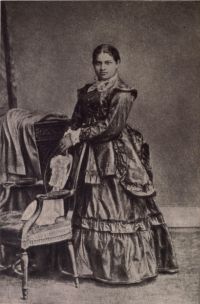 Toru Dutt,
A Sheaf Gleaned in French Fields
(1880)
Toru Dutt,
A Sheaf Gleaned in French Fields
(1880)
“ And recrosses his arms and earth's glory resigns, Hervor, brandishing the steel that vibrates and shines, With her black hair wild streaming, a phantom of dread, Runs, leaps, disappears in the forest's dark lines. ”
T. C. Harbaugh, Little Oskaloo; or, The White Whirlwind
“ The White Whirlwind did not speak until he had mastered the contents of the stolen message in the light of the fire.“Warriors!” he said, in the tone which had been heard above the roar of more than one forest battle, “I see that your council has been opened. I have been on the trail, and though I sought you when the sun went down, I could not get here sooner. Boldly, like a famished wolf, the Blacksnake marches through the forest; he comes to deprive the red man of his cabin, or his lodge, and to drive his children to lands where a deer track has never been seen. ”
author:Homer, Batrachomyomachia, or, the wonderfull and bloudy Battell betweene Frogs and Mice (1634)
“ In spite of envy, slander, death and hell.Hargreve revives from prison of the grave;Above the bankes of Fame his praises swell, Since hissing Serpents sought him to deprave: When Vertue most is spurn'd, he growes most brave. ”
 George Borrow,
Lavengro: The Scholar, the Gypsy…
George Borrow,
Lavengro: The Scholar, the Gypsy…
“ I have a decided penchant for forges, especially rural ones, placed in some quaint quiet spot—a dingle, for example, which is a poetical place, or at a meeting of four roads, which is still more so; for how many a superstition—and superstition is the soul of poetry—is connected with these cross roads! I love to light upon such a one, especially after nightfall, as everything about a forge tells to most advantage at night ”
John Richard Green, History of the English People, Volume I
“ The sparrow flies in at one door and tarries for a moment in the light and heat of the hearth-fire, and then flying forth from the other vanishes into the darkness whence it came. So tarries for a moment the life of man in our sight, but what is before it, what after it, we know not. ”
 Burton Egbert Stevenson,
The Home Book of Verse — Volume 3
Burton Egbert Stevenson,
The Home Book of Verse — Volume 3
“ The high sun sees not, on the earth, such fiery fearful show! The roof-ribs swarth, the candent hearth, the ruddy lurid row Of smiths that stand, an ardent band, like men before the foe! As, quivering through his fleece of flame, the sailing monster slow Sinks on the anvil—all about, the faces fiery grow: "Hurrah!" ”
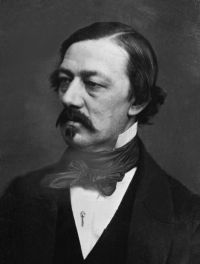 Henry William Herbert,
Wager of Battle: A Tale of Saxon Slavery in Sherwood Forest
Henry William Herbert,
Wager of Battle: A Tale of Saxon Slavery in Sherwood Forest
“ He sat erect on his rock, resolute, with every nerve quivering with intense excitement, with every faculty braced, ready for the last exertion. The cloud fell on him black as midnight; the fierce wind smote his elf-locks, making them stream and shiver in its currents ”
Anna K. Howard, The Canadian Elocutionist
“ In vain his companion whispers the name of father and sister; death is there to dull the pulse, to dim the eye, and to deafen the ear. Death! stern, terrible, and with no soft hand, no gentle voice, to soothe his fevered brow, and calm his troubled soul and bid it hope in God. (Harry sits down and covers his face with his hands) Death overtook him thus; and there, in the midst of the mountain forest, surrounded by Indian tribes, they scooped him a grave in the sand; and without a shroud or coffin, prayer or hymn, they laid him down in the damp earth to his final slumber. ”
 Gilbert Parker,
Parables of a Province
Gilbert Parker,
Parables of a Province
“ THE FORGE IN THE VALLEY He lay where he could see her working at the forge. As she worked she sang: “When God was making the world, (Swift is the wind and white is the fire) The feet of his people danced the stars; There was laughter and swinging bells, And clanging iron and breaking breath, The hammers of heaven making the hills, The vales on the anvil of God. (Wild is the fire and low is the wind.) ”
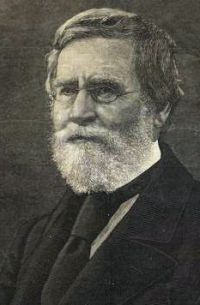 Jacob Abbott,
William the Conqueror
Jacob Abbott,
William the Conqueror
“ Those of King Harold's followers that had escaped the slaughter of the day fled in hopeless confusion toward the north, where the flying masses strewed the roads for miles with the bodies of men who sank down on the way, spent with wounds or exhausted by fatigue. ”
 Otto Rank,
The Myth of the Birth of the Hero…
Otto Rank,
The Myth of the Birth of the Hero…
“ When the herder hurriedly arrived, on the command of Harpagos, the latter said to him: “Astyages bids thee take this boy and expose him in the wildest mountains, that he may perish as promptly as may be, and the King has ordered me to say to thee: If thou doest not kill the boy, but let him live, in whatever way, thou art to die a most disgraceful death. And I am charged to see to it that the boy is really exposed.” When the herder had listened to this, he took the boy, went home, and arrived in his cottage. ”
George Borrow,
Lavengro: The Scholar, the Gypsy…
“ I never see a forge at night, when seated on the back of my horse at the bottom of a dark lane, but I somehow or other associate it with the exploits of this extraordinary fellow, with many other extraordinary things, amongst which, as I have hinted before, are particular passages of my own life, one or two of which I shall perhaps relate to the reader. ”
Various, Harper's Round Table, November 3…
“ Shrieks, yells, the rumble of the firing, dark forms leaping like madmen with uplifted arms, or bending like wild-beasts over objects on the sand. It was a tumult of horror beyond words. After a little the confusion lessened, and there was a pause, followed by the howl of triumph which is the Indian's pæan of victory. Harold, primped out by his wild run, had hidden behind a sand hill for breath, within a stone's-throw of the scene, for the savages, absorbed in their work of death, had not noticed his advancing figure. ”
 Edmund Leamy,
By the Barrow River, and Other Stories
Edmund Leamy,
By the Barrow River, and Other Stories
“ The harper paused, the maiden’s lashes hid her eyes, and a blush like that which follows the grey light of the dawn stole to her cheeks. The harper was about to make reply when the raven, from the rafter, and behind where we were sitting, croaked, “Grob! grob!”“A soldier is coming,” said the old harper. ”
 Jacob Grimm,
Grimm's Household Tales
(1884)
Jacob Grimm,
Grimm's Household Tales
(1884)
“ Like an arrow, the pike darted away, and with him the herring, the gudgeon, the perch, the carp, and all the rest of them. Even the sole swam with them, and hoped to reach the winning-place. All at once, the cry was heard, "The herring is first! the herring is first!" "Who is first?" screamed angrily the flat envious sole, who had been left far behind, "who is first?" "The herring! The herring," was the answer. "The naked herring?" cried the jealous creature, "the naked herring?" ”
 Hippolyte Taine,
History of English Literature Volume 1…
Hippolyte Taine,
History of English Literature Volume 1…
“ Then should the harper become so sorrowful that he could not remain among the men, but frequented the wood, and sat on the mountains, both day and night, weeping and harping, so that the woods shook, and the rivers stood still, and no hart shunned any lion, nor hare any hound; nor did cattle know any hatred, or any fear of others, for the pleasure of the sound. Then it seemed to the harper that nothing in this world pleased him. Then thought he that he would seek the gods of hell, and endeavor to allure them with his harp, and pray that they would give him back his wife. ”
Henry William Herbert,
The Knights of England, France…
“ Just as he reached the brow the gates flew open, and the loveliest girl that ever met a sire’s embrace, rushed forth with her attendants—the sternness melted from the old warrior’s brow, as he clasped her to his bosom, before he entered the dark portal. Within that mountain fortalice long lay the Christian warrior, struggling midway between the gates of life and death ”