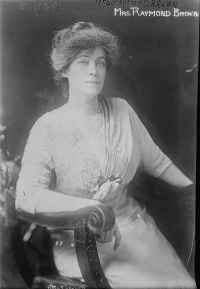
Gertrude Foster Brown

Gertrude Foster Brown

Summary

Portrait of Gertrude Foster Brown Gertrude Foster Brown Your vote and how to use it (1918)

We have come and gone as we chose; we have thought and spoken as we pleased; we have worshiped as we would; our property has been safe; we have damned the government or any man in any public office without thought of danger to ourselves; we have feared no man. Why should we have talked about liberty or human freedom—it has been secure enough. So the call to defend liberty to some has fallen on dull ears, and the demand for an awakened patriotism in some places has gone unheeded.
Source: Gutenberg

Portrait of Gertrude Foster Brown Gertrude Foster Brown Your vote and how to use it (1918)

There is also a part that sees in government only their own selfish profit, but they are also a minority. The great mass of people are indifferent until something arouses them. They would rather be left alone by bad government than be bothered by good government. That is the great problem of democracy—to arouse all the people to a realization of the necessity of their active interest in and support of that democracy, to increase their sense of individual responsibility; and that is the reason for universal suffrage—to put yeast into a people and to ferment their dormant interest.
Source: Gutenberg

Portrait of Gertrude Foster Brown Gertrude Foster Brown Your vote and how to use it (1918)

Streets and roads do not need to be bare and ugly. Some attention paid to appearance costs very little and is a distinct benefit to the public. Weeds are usually cut down along the roadside, but so, too often, are the trees. When one thinks of the many years it takes for a tree to attain a fine growth, one wonders at the carelessness with which they are sacrificed. A well-shaded road bordered by trees, or a shaded city street, testifies to the intelligence and thrift of the people responsible for them.
Source: Gutenberg

Get perspective with Kwize: daily news enlightened by great literature