Summary

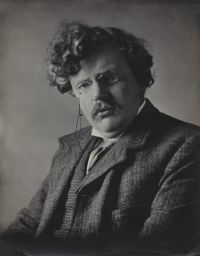
Portrait of Gilbert Keith Chesterton Gilbert Keith Chesterton Appreciations and Criticisms of the Works of Charles Dickens… (1911)

Arcadian poets and Arcadian painters have striven to express happiness by means of beautiful figures. Dickens understood that happiness is best expressed by ugly figures. In beauty, perhaps, there is something allied to sadness; certainly there is something akin to joy in the grotesque, nay, in the uncouth. There is something mysteriously associated with happiness not only in the corpulence of Falstaff and the corpulence of Tony Weller, but even in the red nose of Bardolph or the red nose of Mr. Stiggins. A thing of beauty is an inspiration for ever -- a matter of meditation for ever.
Source: Wikisource

Portrait of Gilbert Keith Chesterton Gilbert Keith Chesterton Appreciations and Criticisms of the Works of Charles Dickens… (1911)

Thus literature has almost always failed in endeavouring to describe happiness as a state. Human tradition, human custom and folk-lore (though far more true and reliable than literature as a rule) have not often succeeded in giving quite the correct symbols for a real atmosphere of camaraderie and joy. But here and there the note has been struck with the sudden vibration of the vox humana. In human tradition it has been struck chiefly in the old celebrations of Christmas. In literature it has been struck chiefly in Dickens's Christmas tales.
Source: Wikisource

Portrait of Gilbert Keith Chesterton Gilbert Keith Chesterton Appreciations and Criticisms of the Works of Charles Dickens… (1911)

Everywhere there is a limitation, a restraint; at one moment the door is shut, at the moment after it is opened. The hour has come or it has not come; the parcels are undone or they are not undone; there is no evolution of Christmas presents. This sharp and theatrical quality in pleasure, which human instinct and the mother wit of the world has wisely put into the popular celebrations of Christmas, is also a quality which is essential in such romantic literature as Dickens wrote. In romantic literature the hero and heroine must indeed be happy, but they must also be unexpectedly happy.
Source: Wikisource

Get perspective with Kwize: daily news enlightened by great literature