Summary

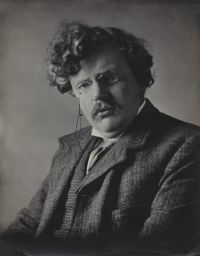
Portrait of Gilbert Keith Chesterton Gilbert Keith Chesterton Charles Dickens — XI: On the Alleged Optimism of Dickens (1906)

If there is anywhere m his novels an instant of silence, we only hear more clearly the hero whispering with the heroine, the villain sharpening his dagger, or the creaking of the machinery that is to give out the god from the machine. He could splendidly describe gloomy places, but he could not describe dreary places. He could describe miserable marriages, but not monotonous marriages. It must have been genuinely entertaining to be married to Mr. Quilp. This sense of a still incessant excitement he spreads over every inch of his story, and over every dark tract of his landscape.
Source: Wikisource

Portrait of Gilbert Keith Chesterton Gilbert Keith Chesterton Charles Dickens — XI: On the Alleged Optimism of Dickens (1906)

He may force himself to say that emptiness is good, but he will hardly prevent himself from asking what is the good of such good. This optimism does exist -- this optimism which is more hopeless than pessimism -- this optimism which is the very heart of hell.
Against such an aching vacuum of joyless approval there is only one antidote -- a sudden and pugnacious belief in positive evil. This world can be made beautiful again by beholding it as a battlefield. When we have defined and isolated the evil thing, the colours come back into everything else.
Source: Wikisource

Portrait of Gilbert Keith Chesterton Gilbert Keith Chesterton Charles Dickens — XI: On the Alleged Optimism of Dickens (1906)

What possessed Dickens to make her such a dehumanised prig as to recommend her husband to marry another woman? One could easily respect a husband who after time and development made such a marriage, but surely not a wife who desired it. If Dora had died hating Agnes we should know that everything was right, and that God would reconcile the irreconcilable. When Dora dies recommending Agnes we know that everything is wrong, at least if hypocrisy and artificiality and moral vulgarity are wrong. There, again, Dickens yields to a mere desire to give comfort.
Source: Wikisource

Get perspective with Kwize: daily news enlightened by great literature