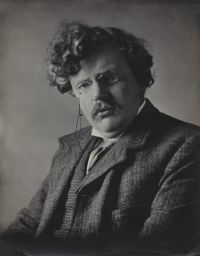
Gilbert Keith Chesterton

Gilbert Keith Chesterton

Summary

Portrait of Gilbert Keith Chesterton Gilbert Keith Chesterton Charles Dickens — III: The Youth of Dickens (1906)

For him ever afterwards these streets were mortally romantic; they were dipped in the purple dyes of youth and its tragedy, and rich with irrevocable sunsets.
Herein is the whole secret of that eerie realism with which Dickens could always vitalise some dark or dull corner of London. There are details in the Dickens descriptions -- a window, or a railing, or the keyhole of a door -- which he endows with demoniac life. The things seem more actual than things really are. Indeed, that degree of realism does not exist in reality; it is the unbearable realism of a dream.
Source: Wikisource

Portrait of Gilbert Keith Chesterton Gilbert Keith Chesterton Charles Dickens — III: The Youth of Dickens (1906)

That wild word, "Moor Eeffoc," is the motto of all effective realism; it is the masterpiece of the good realistic principle -- the principle that the most fantastic thing of all is often the precise fact. And that elfish kind of realism Dickens adopted everywhere. His world was alive with inanimate object. The date on the door danced over Mr. Grewgious's, the knocker grinned at Mr. Scrooge, the Roman on the ceiling pointed down at Mr. Tulkinghorn, the elderly armchair leered at Tom Smart -- these are all moor eeffocish things. A man sees them because he does not look at them.
Source: Wikisource

Portrait of Gilbert Keith Chesterton Gilbert Keith Chesterton Charles Dickens — III: The Youth of Dickens (1906)

When we shut out the street, we are shut out of the street. Few of us understand the street. Even when we step into it, as into a house or room of strangers. Few of us see through the shining riddle of the street, the strange folk that belong to the street only -- the street-walker or the street-arab, the nomads who, generation after generation, have kept their ancient secrets in the full blaze of the sun. Of the street at night many of us know even less. The street at night is a great house locked up. But Dickens had, if ever man had, the key of the street
Source: Wikisource

Get perspective with Kwize: daily news enlightened by great literature