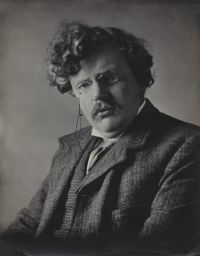
Gilbert Keith Chesterton

Gilbert Keith Chesterton

Summary

Portrait of Gilbert Keith Chesterton Gilbert Keith Chesterton Charles Dickens — VIII: The Time of Transition (1906)

Moreover, of course, a touch of fiction is almost always essential to the real conveying of fact, because fact, as experienced, has a fragmentariness which is bewildering at first hand and quite blinding at second hand. Facts have at least to be sorted into compartments and the proper head and tail given back to each. The perfection and pointedness of art are a sort of substitute for the pungency of actuality. Without this selection and completion our life seems a tangle of unfinished tales, a heap of novels, all volume one. Dickens determined to make one complete novel of it.
Source: Wikisource

Portrait of Gilbert Keith Chesterton Gilbert Keith Chesterton Charles Dickens — VIII: The Time of Transition (1906)

We all know that they exist. We all know the stiff-necked and humorous old-fashioned nurse, so conventional and yet so original, so dependent and yet so independent. We all know the intrusive stepfather, the abstract strange male, coarse, handsome, sulky, successful, a breaker-up of homes. We all know the erect and sardonic spinster, the spinster who is so mad in small things and so sane in great ones. We all know the cock of the school; we all know Steerforth, the creature whom the gods love and even the servants respect.
Source: Wikisource

Portrait of Gilbert Keith Chesterton Gilbert Keith Chesterton Charles Dickens — VIII: The Time of Transition (1906)

They are real people romantically felt; that is to say, they are real people felt as real people feel them. They are exaggerated, like all Dickens's figures: but they are not exaggerated as personalities are exaggerated by an artist; they are exaggerated as personalities are exaggerated by their own friends and enemies. The strong souls are seen through the glorious haze of the emotions that strong souls really create. We have Murdstone as he would be to a boy who hated him; and rightly, for a boy would hate him. We have Steerforth as he would be to a boy who adored him
Source: Wikisource

Get perspective with Kwize: daily news enlightened by great literature