Summary

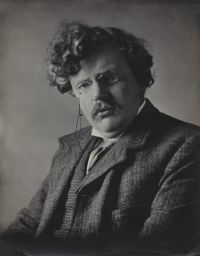
Portrait of Gilbert Keith Chesterton Gilbert Keith Chesterton The New Jerusalem — Chapter X: The Endless Empire (1920)

In the East the civilisation lived on, or if you will, lingered on; in the West it died and was reborn. But for a long time, it should be remembered, it must have seemed to the East merely that it died. The realms of Rome had disappeared in clouds of barbaric war, while the realms of Byzantium were still golden and gorgeous in the sun. The men of the East did not realise that their splendour was stiffening and growing sterile, and even the early successes of Islam may not have revealed to them that their rule was not only stiff but brittle.
Source: Wikisource

Portrait of Gilbert Keith Chesterton Gilbert Keith Chesterton The New Jerusalem — Chapter X: The Endless Empire (1920)

We must remember Rome as well as Byzantium; as indeed nobody would remember Byzantium if it were not for Rome. The more I saw of a hundred little things the more my mind revolved round that original idea which may be called the Mediterranean; and the fact that it became two empires, but remained one civilisation, just as it has become two churches, but remained one religion.
In this little world there is a story attached to every word; and never more than when it is the wrong word. For instance, we may say that in certain cases the word Roman actually means Greek.
Source: Wikisource

Portrait of Gilbert Keith Chesterton Gilbert Keith Chesterton The New Jerusalem — Chapter X: The Endless Empire (1920)

But as a fact the eagle I saw was not borrowed from the Russian Empire; it would be truer to say that the Empire was borrowed from the eagle. The double eagle is the ancient emblem of the double empire of Rome and of Byzantium; the one head looking to the west and the other to the east, as if it spread its wings from the sunrise to the sunset. Unless I am mistaken, it was only associated with Russia as late as Peter the Great, though it had been the badge of Austria as the representative of the Holy Roman Empire.
Source: Wikisource

Get perspective with Kwize: daily news enlightened by great literature