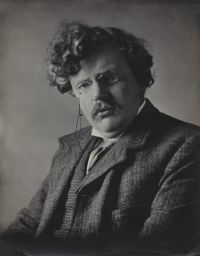
Gilbert Keith Chesterton

Gilbert Keith Chesterton

Summary

Portrait of Gilbert Keith Chesterton Gilbert Keith Chesterton What's Wrong with the World — Chapter 1 part 5 (1910)

Whatever is the matter with modern England it is not that we have carried out too literally, or achieved with disappointing completeness, either the Catholicism of Becket or the equality of Marat. Now I have taken these two cases merely because they are typical of ten thousand other cases; the world is full of these unfulfilled ideas, these uncompleted temples. History does not consist of completed and crumbling ruins; rather it consists of half-built villas abandoned by a bankrupt-builder. This world is more like an unfinished suburb than a deserted cemetery.
Source: Wikisource

Portrait of Gilbert Keith Chesterton Gilbert Keith Chesterton What's Wrong with the World — Chapter 1 part 5 (1910)

Whether the history of the English aristocracy, from the spoliation of the monasteries to the annexation of the mines, entirely supports this theory I am not now inquiring; but certainly it is our theory, that wealth will be a protection against political corruption. The English statesman is bribed not to be bribed. He is born with a silver spoon in his mouth, so that he may never afterwards be found with the silver spoons in his pocket.
Source: Wikisource

Portrait of Gilbert Keith Chesterton Gilbert Keith Chesterton What's Wrong with the World — Chapter 1 part 5 (1910)

The idea was to create an invisible kingdom, without armies or prisons, but with complete freedom to condemn publicly all the kingdoms of the earth. Whether such a supreme church would have cured society we cannot affirm definitely; because the church never was a supreme church. We only know that in England at any rate the princes conquered the saints. What the world wanted we see before us; and some of us call it a failure. But we cannot call what the church wanted a failure, simply because the church failed.
Source: Wikisource

Get perspective with Kwize: daily news enlightened by great literature