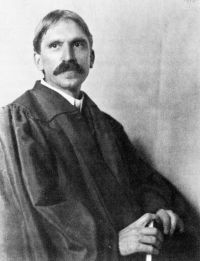
John Dewey

John Dewey

Summary

Portrait of John Dewey John Dewey The Philosophical Review (1892)

Speaking more accurately, the self supervenes, not completely or as an adequately compelling reality, but only as the thought of an ideal. It supervenes, not as a power active in its own satisfaction, but to make us realize the unsatisfactoriness of such seeming satisfactions as we may happen to get, and to keep us striving for something which we can never get! Surely, if Green is correct, he has revealed the illusion which has kept men striving for something which they cannot get, and, the illusion detected, men will give up the strife which leads only to dissatisfaction.
Source: Wikisource

Portrait of John Dewey John Dewey The Philosophical Review (1892)

Only because the institutions of life had through centuries of conception finally given birth to this idea as their own idea and reality, could Green use this idea to condemn those institutions. Such is the irony of all history; it so thoroughly realizes and embodies ideas that these very ideas are turned against it as its own condemnation. But the life which is going on in history, instead of accusing its children of their ungratefulness, makes use of the very ideas by which it is condemned to secure still wider revelation of its own meaning.
Source: Wikisource

Portrait of John Dewey John Dewey The Philosophical Review (1892)

Or as Green puts it: "Only through society is any one enabled to give that effect to the idea of man as the object of his actions, to the idea of a possible better state of himself, without which the idea would remain like that of space to a man who had not the senses either of sight or of touch," — that is, a merely ideal possibility, without actual meaning. And yet society necessarily puts such limits upon the individual that he cannot by his life in society give effect to the idea.
Source: Wikisource

Get perspective with Kwize: daily news enlightened by great literature