Summary

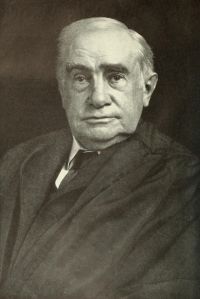
Portrait of Henry Billings Brown Henry Billings Brown Morgan Envelope Company v. Albany Perforated Wrapping Paper Company…

If the claim be good, it would seem to follow that any band of paper wound in such manner that the internal diameter is greater than the thickness of the paper would be an infringement, whatever be its shape, or for whatever purpose used. The size of the roll, too, is not made material, except that it must bear a certain relation to its inner diameter. Certainly it would apply to all toilet paper, even if wound in a cylindrical form, as the language of the claim, though not of the specification, indicates that it should be.
Source: Wikisource

Portrait of Henry Billings Brown Henry Billings Brown Morgan Envelope Company v. Albany Perforated Wrapping Paper Company…

So, too, if the patent were construed as for an oblong roll, the fact that, from time immemorial, cotton and woolen goods and silks have been almost universally wound about a flat board or core, precisely as described in the patent, would indicate that there is no novelty in the oblong or oval shape, and that the patent, if supported at all, must be for the different purpose for which toilet paper is wound in this form.
Source: Wikisource

Portrait of Henry Billings Brown Henry Billings Brown Morgan Envelope Company v. Albany Perforated Wrapping Paper Company…

In this case, however, the purchaser of the new roll does precisely what the patentee intended he should do; he replaces that which is in its nature perishable, and without the replacement of which the remainder of the device is of no value. The replacement is of a product which it is the object of the mechanism to deliver. The case is more nearly analogous to that of Wilson v. Simpson, 9 How. 109, in which the invention involved was a planing machine, and the patent sued upon covered the combination with the cutting knives or planes of a pressure roller to effect the planing of the planks.
Source: Wikisource

Get perspective with Kwize: daily news enlightened by great literature