Summary

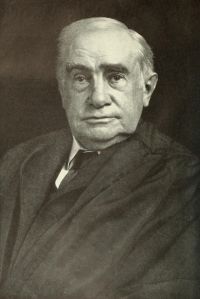
Portrait of Henry Billings Brown Henry Billings Brown Sessions v. Romadka — Opinion of the Court

We think that section 4917 ought to be read in connection with section 4922, providing that the patentee may maintain a suit at law or in equity for the infringement of any part of the thing patented, notwithstanding the specifications may embrance more than that of which the patentee was the first inventor or discoverer; but, in every such case in which a judgment or decree shall be rendered for the plaintiff, no costs shall be recovered, unless the proper disclaimer has been entered at the patent office before the commencement of the suit.
Source: Wikisource

Portrait of Henry Billings Brown Henry Billings Brown Sessions v. Romadka — Opinion of the Court

The essential feature of the Taylor patent consists of a plate attached to the body of the trunk, which contains a socket and hinged catch, and a double-acting spring, whose function is to hold the catch either open or shut, and a tang fastened to the lid, which, as the lid is closed, drops into the socket hole in the catch, which, when closed, holds the lid firmly in place.
Source: Wikisource

Portrait of Henry Billings Brown Henry Billings Brown Sessions v. Romadka — Opinion of the Court

The Roulstone patent of 1866 is for an improvement in traveling bags, and shows a spring-locking device for securing the two parts of the bag firmly together. It has no features in common with the trunk fastener of Taylor, and is not adapted to hold the lid of a trunk firmly to the body. It has no means for holding the catch out of engagement when desired, and is wholly unlike the modern trunk fastener.
Source: Wikisource

Get perspective with Kwize: daily news enlightened by great literature