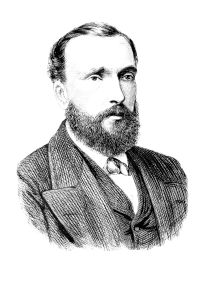
Henry Charlton Bastian

Henry Charlton Bastian

Summary

Portrait of Henry Charlton Bastian Henry Charlton Bastian,  Popular Science Monthly (1874)

“ But whether we follow the philosopher in his bold speculations concerning the past, or listen to the biologist making his predictions concerning the future stages which the germ of a given animal will pass through in the progress of its evolution—in each case the "uniformity of Nature" is tacitly assumed. This assumption underlies almost all our thoughts and actions, even in every-day life. And, without such a belief in the Uniformity of Nature, science would be impossible—the very idea of it, in fact, could never have arisen. ”
Source: Wikisource

Portrait of Henry Charlton Bastian Henry Charlton Bastian,  Popular Science Monthly (1874)

“ If an evolution of living matter occurred only far back beyond the depths of geologically-recorded time, and if, as Mr. Darwin [16] would have us believe, "all the living forms of life are the lineal descendants of those which lived long before the Cambrian epoch," how is the Evolutionist to explain the existence of the multitudinous myriads of lowest and almost structureless organisms which exist at the present day? ”
Source: Wikisource

Portrait of Henry Charlton Bastian Henry Charlton Bastian,  Popular Science Monthly (1874)

“ For, however deficient our knowledge may be upon this subject, we may feel assured that life shows less of the characters of life in the egg than in the organism which is born from it. The life of the egg is "very feeble"—"its life has less of life." And then Spallanzani asks whether the fact of this life of the embryo within the egg being "so small and so feeble"—being "a life which deserves so little the name of life"—may not be the reason that eggs are able to bear the influence of heat better than the developed organisms whose life is more active and complex? ”
Source: Wikisource

Get perspective with Kwize: daily news enlightened by great literature