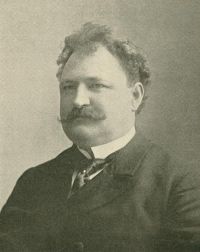
Henry Edward Krehbiel

Henry Edward Krehbiel

Summary

Portrait of Henry Edward Krehbiel Henry Edward Krehbiel A Second Book of Operas

The maiden recoils in terror. A priest had taught her in an allegory that Pleasure and Death were one! Osaka loads her with jewels, fondles her, draws her to his breast, kisses her passionately. Iris weeps. She knows nothing of passion, and longs only for her father, her cottage, and her garden. Osaka wearies of his guest, but Kyoto plans to play still further upon his lust. He clothes her in richer robes, but more transparent, places her upon a balcony, and, withdrawing a curtain, exhibits her beauty to the multitude in the street.
Source: Gutenberg

Portrait of Henry Edward Krehbiel Henry Edward Krehbiel A Second Book of Operas

The oncoming waves of the drama's pathos have risen to a supreme height, their crests have broken, and the wind-blown spume drenches the soul of the listeners; but the composer has not departed from the first principle of the master of whom, for a time, it was hoped he might be the legitimate successor. Melody remains the life-blood of his music as it is that of Verdi's from his first work to his last;—as it will be so long as music endures.
Source: Gutenberg

Portrait of Henry Edward Krehbiel Henry Edward Krehbiel A Second Book of Operas

But no time is lost; the spectacle does not make the action halt for a moment. Sheba makes her gifts and uncovers her face, and at once we are confronted by the tragical element, and the action rushes on toward its legitimate and mournful end.
In this ingenious blending of play and spectacle one rare opportunity after another is presented to the composer. Sulamith's epithalamium, Assad's narrative, the choral greeting to the Queen, the fateful recognition—all these things are made for music of the inspiring, swelling, passionate kind.
Source: Gutenberg

Get perspective with Kwize: daily news enlightened by great literature