Summary

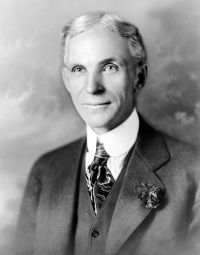
Portrait of Henry Ford Henry Ford My Life and Work — 8. Wages (1922)

When we try to regulate wages according to the cost of living, we are imitating a dog chasing his tail. And, anyhow, who is competent to say just what kind of living we shall base the costs on? Let us broaden our view and see what a wage is to the workmen--and what it ought to be.
The wage carries all the worker's obligations outside the shop; it carries all that is necessary in the way of service and management inside the shop. The day's productive work is the most valuable mine of wealth that has ever been opened. Certainly it ought to bear not less than all the worker's outside obligations.
Source: Wikisource

Portrait of Henry Ford Henry Ford My Life and Work — 8. Wages (1922)

But if that business does warrant higher wages and the employer refuses, what is to be done? As a rule a business means the livelihood of too many men, to be tampered with. It is criminal to assassinate a business to which large numbers of men have given their labours and to which they have learned to look as their field of usefulness and their source of livelihood. Killing the business by a strike or a lockout does not help. The employer can gain nothing by looking over the employees and asking himself, "How little can I get them to take?"
Source: Wikisource

Portrait of Henry Ford Henry Ford My Life and Work — 8. Wages (1922)

Whenever a man finds the management of a business too much for his own time or strength, he calls in assistants to share the management with him. Why, then, if a man finds the production part of a business too much for his own two hands should he deny the title of "partner" to those who come in and help him produce? Every business that employs more than one man is a kind of partnership. The moment a man calls for assistance in his business--even though the assistant be but a boy--that moment he has taken a partner.
Source: Wikisource

Get perspective with Kwize: daily news enlightened by great literature