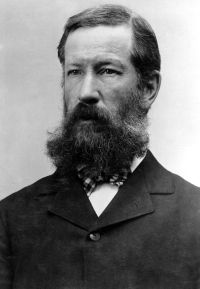
Henry Gannett

Henry Gannett

Summary

Portrait of Henry Gannett Henry Gannett,  Popular Science Monthly (1880)

“ The dry atmosphere and the parched earth have absorbed it, and a dry cañon alone remains to mock the thirsty traveler. Reaching the edge of one of these cañons, five hundred or perhaps a thousand feet deep, with precipitous sides, one experiences a feeling akin to superstitious fear when, after descending to the bottom, and fully expecting to hear the rushing of a torrent of crystal water, he finds only a stream-bed of hot, glistening sand. ”
Source: Wikisource

Portrait of Henry Gannett Henry Gannett,  Popular Science Monthly (1882)

“ When an elevation commences gradually across the course of a river, its first effect is to lessen the rapidity of the current above the crest of the elevation and to increase it below that point. The erosive power of a stream is proportional, other things being equal, to the rapidity of its current. Erosion is therefore more rapid below the crest. But this erosion not only deepens the bed of the stream below the crest, but also pares away the crest, from down-stream upward, so that the point where the velocity of the stream changes is constantly tending up-stream. ”
Source: Wikisource

Portrait of Henry Gannett Henry Gannett,  Popular Science Monthly (1880)

“ One by one their warriors fell; step by step they were driven southward, until at last, totally discouraged and disheartened, and with ranks terribly thinned, they abandoned the homes of their fathers, and wandered southward, some to build on almost inaccessible heights—the Moquis towns of the present day—some to wander to the site of Zuni, others to the Rio Grande, where their descendants are found to-day: but, as is so often the case with a people forcibly transplanted from their native soil, they have deteriorated from their former state of civilization. ”
Source: Wikisource

Get perspective with Kwize: daily news enlightened by great literature