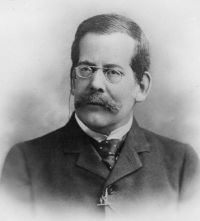
Henry Sweet

Henry Sweet

Summary

Portrait of Henry Sweet Henry Sweet 1911 Encyclopædia Britannica (1911)

Grimm had, at last, awakened to the full conviction that all sound philology must be based on rigorous adhesion to the laws of sound-change, and he never afterwards swerved from this principle, which gave to all his investigations, even in their boldest flights, that iron-bound consistency, and that force of conviction which distinguish science from dilettanteism; up to Grimm’s time philology was nothing but a more or less laborious and conscientious dilettanteism, with occasional flashes of scientific inspiration; he made it into a science.
Source: Wikisource

Portrait of Henry Sweet Henry Sweet 1911 Encyclopædia Britannica (1911)

The German orthography is comparatively phonetic: it has hardly any silent letters, and it generally has one symbol for each sound, each symbol having only one value, the exceptions falling under a few simple rules, which are easily remembered. There are other languages which have still more phonetic orthographies, such as Spanish, Welsh and Finnish. But even the best of them are not perfect: even when they are not actually misleading, they are always inadequate. On the other hand, no system of writing is wholly unphonetic.
Source: Wikisource

Portrait of Henry Sweet Henry Sweet 1911 Encyclopædia Britannica (1911)

The grammar stands alone in the annals of science for comprehensiveness, method and fullness of detail. Every law, every letter, every syllable of inflection in the different languages is illustrated by an almost exhaustive mass of material. It has served as a model for all succeeding investigators. Diez’s grammar of the Romance languages is founded entirely on its methods, which have also exerted a profound influence on the wider study of the Indo-Germanic languages in general.
In the great German dictionary Grimm undertook a task for which he was hardly suited.
Source: Wikisource

Get perspective with Kwize: daily news enlightened by great literature