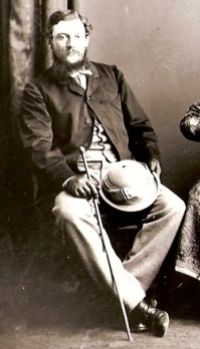
Henry Walter Bellew

Henry Walter Bellew

Summary

Portrait of Henry Walter Bellew Henry Walter Bellew From the Indus to the Tigris (1874)

At about six miles we crested the Tappa Salám, or “ridge of obeisance;” and got our first view of Mashhad i mucaddas, “the holy,” with its gilded shrine and blue-domed mosque overtopping the rich foliage of its gardens—a pleasant oasis in the centre of a wide desert plain. Our road companions and Persian attendants, straining their eyes in the direction of their loved city, muttered a prayer, and bowed reverently and low.
In fine weather, the view of the city and the mountains beyond it must be a very pretty sight.
Source: Gutenberg

Portrait of Henry Walter Bellew Henry Walter Bellew From the Indus to the Tigris (1874)

To the south is the great sandy desert, whose bare surface cuts the horizon as does the ocean. To the west lies the wide plain of Sistan, a flat, bare, pebbly tract, the uniformity of which is only broken by the ruins that here and there stud the surface. To the northward winds the Helmand, in a wide channel crowded with tamarisk forest. Beyond the river stretches a widening strip of alluvium, the characteristic features of which are its conspicuous ruins, backed by desert cliffs, which here too cut the horizon in one vast line of unbroken waste.
Source: Gutenberg

Portrait of Henry Walter Bellew Henry Walter Bellew From the Indus to the Tigris (1874)

The village has been decimated by the famine, and wears a gloomy, miserable, and deserted look, in the midst of luxuriant vineyards and orchards, exuberant in their foliage from want of hands to tend and prune them. Its people, such as are left, pale, haggard, and hungry, wander listlessly through its deserted quarters and crumbling tenements, resignedly waiting the ripening of their crops, and eking out the while a miserable subsistence on such stores of fruit and grain as are yet left to them.
Source: Gutenberg

Get perspective with Kwize: daily news enlightened by great literature