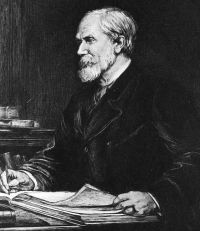
Henry Yule

Henry Yule

Summary

Portrait of Henry Yule Henry Yule,  Hobson-Jobson — C (1903)

“ COIR, s. The fibre of the coco-nut husk, from which rope is made. But properly the word, which is Tam. kayiru, Malayāl. kāyar, from v. kāyāṛu, 'to be twisted,' means 'cord' itself (see the accurate Al-Birūnī below) . The former use among Europeans is very early. And both the fibre and the rope made from it appear to have been exported to Europe in the middle of the 16th century. The word appears in early Arabic writers in the forms ḳānbar and ḳanbār, arising probably from some misreading of the diacritical points (for ḳāiyar, and ḳaiyār) . The Portuguese adopted the word in the form cairo. ”
Source: Wikisource

Portrait of Henry Yule Henry Yule,  Hobson-Jobson — C (1903)

“ CONCAN, n.p. Skt. konkaṇa, [Tam. konkaṇam] , the former in the Pauranic lists the name of a people; Hind. Konkan and Kokan. The low country of Western India between the Ghauts and the sea, extending, roughly speaking, from Goa northward to Guzerat. But the modern Commissionership, or Civil Division, embraces also North Canara (south of Goa) . In medieval writings we find frequently, by a common Asiatic fashion of coupling names, Kokan- or Konkan-Tana; Tana having been a chief place and port of Konkan. ”
Source: Wikisource

Portrait of Henry Yule Henry Yule,  Hobson-Jobson — C (1903)

“ COCO-DE-MER, or DOUBLE COCO-NUT, s. The curious twin fruit so called, the produce of the Lodoicea Sechellarum, a palm growing only in the Seychelles Islands, is cast up on the shores of the Indian Ocean, most frequently on the Maldive Islands, but occasionally also on Ceylon and S. India, and on the coasts of Zanzibar, of Sumatra, and some others of the Malay Islands. Great virtues as medicine and antidote were supposed to reside in these fruits, and extravagant prices were paid for them. ”
Source: Wikisource

Get perspective with Kwize: daily news enlightened by great literature