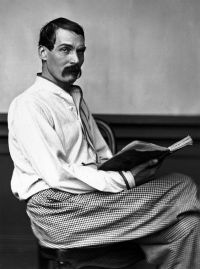
Sir Richard Francis Burton

Sir Richard Francis Burton

Summary

Portrait of Sir Richard Francis Burton Sir Richard Francis Burton Goa and the Blue Mountains; or… (1851)

Neilgherries takes in an extensive range of swelling waving hill, looking at a distance as if a green gulf had suddenly become fixed for ever. On the horizon are lofty steeps, crowned with remnants of forests, studded with patches of cultivation, and seamed with paths, tracks, and narrow roads. There is little or no table-land: the only level road in the vicinity is scarcely a mile long. At the bottom of the hollow lies the bazaar, and upon the rising knolls around are the nine or ten houses which compose the first European settlement you have seen on the Blue Hills.
Source: Gutenberg

Portrait of Sir Richard Francis Burton Sir Richard Francis Burton Goa and the Blue Mountains; or… (1851)

The best houses, you may remark, are built as close to the margin of the lake as possible. Turn your eyes away from the northern bank; that dirty, irregular bazaar is the very reverse of romantic. The beauties of the view lie dispersed above and afar. On both sides of the water, turfy peaks and woody eminences, here sinking into shallow valleys, there falling into steep ravines, the whole covered with a tapestry of brilliant green, delight your eye, after the card-table plains of Guzerat, the bleak and barren Maharatta hills, or the howling wastes of sun-burnt Scinde.
Source: Gutenberg

Portrait of Sir Richard Francis Burton Sir Richard Francis Burton Goa and the Blue Mountains; or… (1851)

Thus the country becomes impassable, the cantonment dirty, every place wretched, every one miserable.
All the visitors have returned to the plains, all the invalids that can afford themselves the luxury, have escaped to Coonoor or Kotagherry. You feel that if you remain at Ootacamund—the affectionate “Ooty” somehow or other now sticks in your throat—you must be contented to sit between the horns of a fierce dilemma. If you stay at home you lose all the pleasure of life: if you do not, still you lose all the pleasure of life.
Source: Gutenberg

Get perspective with Kwize: daily news enlightened by great literature