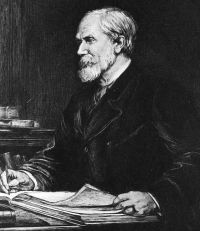
Henry Yule

Henry Yule

Summary

Portrait of Henry Yule Henry Yule Hobson-Jobson — S (1903)

SAPPAN-WOOD, s. The wood of Caesalpina sappan; the baḳḳam of the Arabs, and the Brazil-wood of medieval commerce. Bishop Caldwell at one time thought the Tamil name, from which this was taken, to have been given because the wood was supposed to come from Japan. Rumphius says that Siam and Champa are the original countries of the Sappan, and quotes from Rheede that in Malabar it was called Tsajampangan, suggestive apparently of a possible derivation from Champa.
Source: Wikisource

Portrait of Henry Yule Henry Yule Hobson-Jobson — S (1903)

Skt. sannyāsī, lit. 'one who resigns, or abandons,' scil. 'worldly affairs'; a Hindu religious mendicant. The name of Sunnyásee was applied familiarly in Bengal, c. 1760-75, to a body of banditti claiming to belong to a religious fraternity, who, in the interval between the decay of the imperial authority and the regular establishment of our own, had their head-quarters in the forest-tracts at the foot of the Himālaya.
Source: Wikisource

Portrait of Henry Yule Henry Yule Hobson-Jobson — S (1903)

SIRDAR, s. Hind. from Pers. sardār, and less correctly sirdār, 'leader, a commander, an officer'; a chief, or lord; the head of a set of palankin-bearers, and hence the 'sirdār-bearer,' or elliptically 'the Sirdār,' is in Bengal the style of the valet or body-servant, even when he may have no others under him (see BEARER) . [Sirdār is now the official title of the Commander-in-Chief of the Egyptian army; Sirdār Bahādur is an Indian military distinction.]
Source: Wikisource

Get perspective with Kwize: daily news enlightened by great literature