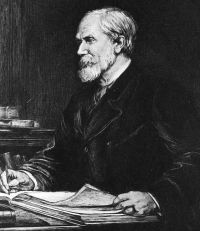
Henry Yule

Henry Yule

Summary

Portrait of Henry Yule Henry Yule,  Hobson-Jobson — B (1903)

“ BHEESTY, s. The universal word in the Anglo-Indian households of N. India for the domestic (corresponding to the saḳḳā of Egypt) who supplies the family with water, carrying it in a mussuck, (q.v.) , or goatskin, slung on his back. The word is P. bihishtī, a person of bihisht or paradise, though the application appears to be peculiar to Hindustan. We have not been able to trace the history of this term, which does not apparently occur in the Āīn, even in the curious account of the way in which water was cooled and supplied in the Court of Akbar (Blochmann, tr. i. 55 seqq.) ”
Source: Wikisource

Portrait of Henry Yule Henry Yule,  Hobson-Jobson — B (1903)

“ BANKSHALL, s. a. A warehouse. b. The office of a Harbour Master or other Port Authority. In the former sense the word is still used in S. India; in Bengal the latter is the only sense recognised, at least among Anglo-Indians; in Northern India the word is not in use. As the Calcutta office stands on the banks of the Hoogly, the name is, we believe, often accepted as having some indefinite reference to this position. And in a late work we find a positive and plausible, but entirely unfounded, explanation of this kind, which we quote below. ”
Source: Wikisource

Portrait of Henry Yule Henry Yule,  Hobson-Jobson — B (1903)

“ BATTA, s. Two different words are thus expressed in Anglo-Indian colloquial, and in a manner confounded.
a. H. bhata or bhātā: an extra allowance made to officers, soldiers, or other public servants, when in the field, or on other special grounds; also subsistence money to witnesses, prisoners, and the like. Military Batta, originally an occasional allowance, as defined, grew to be a constant addition to the pay of officers in India, and constituted the chief part of the excess of Indian over English military emoluments.
”
Source: Wikisource

Get perspective with Kwize: daily news enlightened by great literature