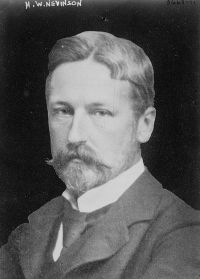
Henry Woodd Nevinson

Henry Woodd Nevinson

Summary

Portrait of Henry Woodd Nevinson Henry Woodd Nevinson The new spirit in India (1908)

From every part of India, by day and night, the pilgrims come, and the roads to the great temple, by the sea at Puri, are always open and always thronged. The pilgrims come from behind the white mountains, and from the purple lands of the south, and across the hot plains from the other ocean. The train that shot me out upon the sand amid a crowd of dim white figures at three o’clock one morning raises a high dividend from religion. Hundreds come by it every day, for it saves time—and under British rule even devotion goes by time.
Source: Gutenberg

Portrait of Henry Woodd Nevinson Henry Woodd Nevinson The new spirit in India (1908)

Having drunk the nectar of freedom, can she turn back to the palm-tree “toddy” of a Government shop, or cease to labour for Swaraj? She claims the right of other nations, the rights for which England herself has fought; she claims the same freedom of person and of speech, and she will not cease to labour for Swaraj. From north to south her people are becoming united, from east to west the cry of “Bande Mataram” goes up, and slowly the sun of freedom is arising: it may rise slowly, but India will not cease to labour for Swaraj.
Source: Gutenberg

Portrait of Henry Woodd Nevinson Henry Woodd Nevinson The new spirit in India (1908)

But whilst we shall continue, as far as politics can foresee, to superintend the administration of India and to protect her from external attack, the danger is that our bureaucracy, always the slowest form of government to realize change, should ignore the new spirit arising in the country, or should seek to stifle rather than guide it. It is the conviction of many that India is now standing on the verge of a national renaissance—a new birth in intellect, social life, and the affairs of state.
Source: Gutenberg

Get perspective with Kwize: daily news enlightened by great literature