“ While this lively breeze continued, Baltimore, our old black cook, was in great tribulation.Like most South Seamen, the Julia's "caboose," or cook-house, was planted on the larboard side of the forecastle. Under such a press of canvas, and with the heavy sea running the barque, diving her bows under, now and then shipped green glassy waves, which, breaking over the head-rails, fairly deluged that part of the ship, and washed clean aft. The caboose-house--thought to be fairly lashed down to its place--served as a sort of breakwater to the inundation. ”
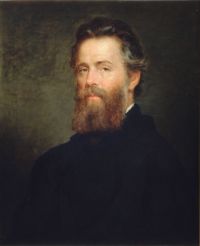
Herman Melville
Summary

"Omoo: A Narrative of Adventures in the South Seas" (1847) is Herman Melville's semi-autobiographical follow-up to Typee, detailing the narrator's adventures after escaping the Marquesas Islands. Aboard a whaling ship, he encounters the volatile politics of Tahiti, a mutiny, and captivity, merging personal experience with imaginative storytelling.
The novel delves into themes of cultural encounter, life at sea, and self-discovery, enriched by striking portrayals of Pacific islands and nautical drama. Melville's combination of memory and researched content anticipates his more developed style, establishing Omoo as a crucial link between his earlier works and the grand vision of Moby-Dick.
Quotes from Omoo (Herman Melville)
“ In other words, the Julia was off.The beach was quite near, and in this quarter altogether uninhabited; so down we ran, and, at cable's length, saw little Jule gliding past--top-gallant-sails hoisting, and a boy aloft with one leg thrown over the yard, loosing the fore-royal. The decks were all life and commotion; the sailors on the forecastle singing "Ho, cheerly men!" as they catted the anchor; and the gallant Jennin, bare-headed as his wont, standing up on the bowsprit, and issuing his orders. By the man at the helm stood Captain Guy, very quiet and gentlemanly, and smoking a cigar. ”
“ A fresh breeze springing up, we set our sail of matting, and glided along as tranquilly as if floating upon an inland stream; the white reef on one hand, and the green shore on the other.Soon, as we turned a headland, we encountered another canoe, paddling with might and main in an opposite direction; the strangers shouting to each other, and a tall fellow in the bow dancing up and down like a crazy man. They shot by us like an arrow, though our fellow-voyagers shouted again and again for them to cease paddling. ”
