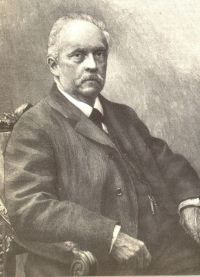
Hermann von Helmholtz

Hermann von Helmholtz

Summary

Portrait of Hermann von Helmholtz Hermann von Helmholtz On the Conservation of Force

Now, the external work of man is of the most varied kind as regards the force or ease, the form and rapidity, of the motions used on it, and the kind of work produced. But both the arm of the blacksmith who delivers his powerful blows with the heavy hammer, and that of the violinist who produces the most delicate variations in sound, and the hand of the lace-maker who works with threads so fine that they are on the verge of the invisible, all these acquire the force which moves them in the same manner and by the same organs, namely, the muscles of the arms.
Source: Wikisource

Portrait of Hermann von Helmholtz Hermann von Helmholtz On the Conservation of Force

We may regard this force as an attractive force between the two, which, however, only acts through them with extraordinary power, if the smallest particles of the two substances are in closest proximity to each other. In combustion this force acts; the carbon and oxygen atoms strike against each other and adhere firmly, inasmuch as they form a new compound—carbonic acid—a gas known to all of you as that which ascends from all fermenting and fermented liquids—from beer and champagne.
Source: Wikisource

Portrait of Hermann von Helmholtz Hermann von Helmholtz On the Conservation of Force

The product of combustion is water, which, therefore, is not of itself further combustible for the hydrogen in it is completely saturated with oxygen. The force of affinity, therefore, of hydrogen for oxygen, like that of carbon for oxygen, performs work in combustion, which appears in the form of heat. In the water which has been formed during combustion, the force of affinity is exerted between the elements as before, but its capacity for work is lost.
Source: Wikisource

Get perspective with Kwize: daily news enlightened by great literature