Summary

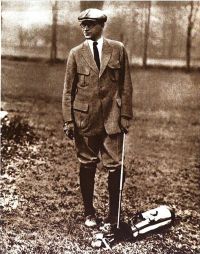
Portrait of Holworthy Hall Holworthy Hall "If You Don't Mind my Telling You" (1917)

As Mr. Mott wavered on the tee, he saw a deep gully, weed-infested and spotted with frowning rocks; he saw pits bounding and guarding the green; he saw trees and excavations and a stone wall. Upon its mound of sand he saw the Silver King waiting resignedly for its certain punishment. He saw his mid-iron, broad bladed and heavy, a club capable of propelling thirty pennyweight of rubber and silk an eighth of a mile if properly handled. Yet Mr. Mott discounted the inherent qualities of that iron, just as he discounted the elasticity of the golf-ball and the power of his wrists and forearms.
Source: Wikisource

Portrait of Holworthy Hall Holworthy Hall "If You Don't Mind my Telling You" (1917)

Mr. Mott flushed, and jabbed again. He lifted himself erect, and poured out into the world the offscourings of his innermost soul. He reviled himself, the Silver King golf-ball, the Vaile putter, the greenskeeper, the turf, the contour of the land, the Scotch who had invented the game, and the promoters who had organized the club. As an afterthought, he hurled the putter into a convenient hazard, and, seizing the first weapon which came to hand,—a niblick,—struck so fair and true that the ball went down for a six, one over par.
Source: Wikisource

Portrait of Holworthy Hall Holworthy Hall "If You Don't Mind my Telling You" (1917)

Mott entered it, echoed the mad confusion of a political convention crossed with a dairy restaurant. Crockery clattered against wooden surfaces, plated silver clattered against crockery, tumblers clinked to tumblers, and hobnails grated on the red-tiled floor. Men in knickerbockers and men in flannels huddled close to the round tables and bawled statistics at one another; men in street clothes dragged rattling caddy-bags through from the office; men flushed and perspiring stamped in from the eighteenth green, and clamored loudly at the bar.
Source: Wikisource

Get perspective with Kwize: daily news enlightened by great literature