“ You have proved to me that Camille is a man; she swims, hunts, smokes, drinks, rides on horseback, writes and analyzes hearts and books; she has no weaknesses; she marches on in all her strength; her motions even have no resemblance to your graceful movements, to your step, airy as the flight of a bird. Neither has she your voice of love, your tender eyes, your gracious manner; she is Camille Maupin; there is nothing of the woman about her, whereas in you are all the things of womanhood that I love. It has seemed to me, from the first moment when I saw you, that you were mine. ”
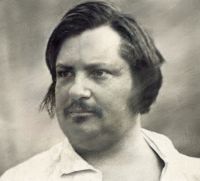
Honoré de Balzac
Summary
Honoré de Balzac’s Beatrix, part of his broader examination of French society and gender dynamics, focuses on the intricate relationship between love, social class, and personal identity. The novel traces the lives of characters such as Calyste, Beatrix, and the enigmatic Camille, whose rejection of conventional femininity questions societal expectations.
Themes of female autonomy, the conflict between emotional sensitivity and mental fortitude, and the impact of aristocratic status run through the narrative, evident in passages that contrast the "graceful movements" of idealized womanhood with the confident, almost masculine characteristics of figures like Camille. Balzac’s depiction of relationships—characterized by fervor, competition, and deep yearning—ultimately highlights his fascination with the paradoxes of human longing and the limitations imposed by social structure.
Quotes from Beatrix (Honoré de Balzac)
Honoré de Balzac,
Beatrix
(1839)
“ I have no reason, my dear, to be satisfied with you, and I am too frank to hide my dissatisfaction. No one has ever given or ever will give, perhaps, so cruel a wound to my heart as that from which I am now suffering. If you are not a woman in love, you are one in vengeance. It takes a woman of genius to discover the most sensitive spot of all in another woman's delicacy. I am talking now of Calyste, and the trickery, my dear,—that is the word,—trickery,—you have employed against me. To what depths have you descended, Camille Maupin! ”
“ No sooner did Calyste see the vanes of the two gables shooting up beyond the furze of the roadside and the distorted heads of the pines, than the air seemed lighter; Guerande was a prison to him; his life was at Les Touches. Who will not understand the attraction it presented to a youth in his position. A love like that of Cherubin, had flung him at the feet of a person who was a great and grand thing to him before he thought of her as a woman, and it had survived the repeated and inexplicable refusals of Felicite. ”
