“ The town of Guerande, which for two months past had seen Calyste, its flower and pride, going, morning or evening, often morning and evening, to Les Touches, concluded that Mademoiselle Felicite des Touches was passionately in love with the beautiful youth, and that she practised upon him all kinds of sorceries. More than one young girl and wife asked herself by what right an old woman exercised so absolute an empire over that angel. When Calyste passed along the Grand Rue to the Croisic gate many a regretful eye was fastened on him. ”
Quotes about “Calyste”
“ Calyste turned scarlet from his neck to his forehead; even his ears were on fire. “Oh! forgive me,” she cried. “How can I heedlessly deprave your girlish innocence! Forgive me, Calyste—” She paused. “There are some superb, consistent natures who say at a certain age: ‘If I had my life to live over again, I would do the same things.’ I who do not think myself weak, I say, ‘I would be a woman like your mother, Calyste.’ To have a Calyste, oh! what happiness! I could be a humble and submissive woman—And yet, I have done no harm except to myself. ”
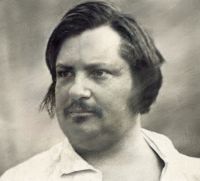 Honoré de Balzac,
Beatrix
(1839)
Honoré de Balzac,
Beatrix
(1839)
“ During breakfast, which Calyste was invited to share, the marquise, whose sentiments could be noble and generous, made a sudden return upon herself, resolving to stifle the germs of love which were rising in her heart. She was neither cold nor hard to Calyste, but gently indifferent,—a course which tortured him. Felicite brought forward a proposition that they should make, on the next day but one, an excursion into the curious and interesting country lying between Les Touches, Croisic, and the village of Batz. ”
“ As he walked toward Croisic, to engage the boatmen, fears came into Calyste’s mind. Camille’s speech foreshadowed something fatal, and he believed in the second sight of her maternal affection. When he returned, four hours later, very tired, and expecting to dine at Les Touches, he found Camille’s maid keeping watch over the door, to tell him that neither her mistress nor the marquise could receive him that evening. Calyste, much surprised, wished to question her, but she bade him hastily good-night and closed the door. ”
“ Not only had Music arisen before the eyes of Calyste, touching him with her divine wand until he stood in presence of Creation from which she rent the veil, but he was dumfounded by Conti’s genius. In spite of what Camille had told him of the musician’s character, he now believed in the beauty of the soul, in the heart that expressed such love. How could he, Calyste, rival such as an artist? What woman could ever cease to adore such genius? That voice entered the soul like another soul. The poor lad was overwhelmed by poesy, and his own despair. ”
Honoré de Balzac,
Beatrix
(1839)
“ Young lovers are like hungry men; kitchen odors will not appease their hunger; they think too much of what is coming to care for the means that bring it. As Calyste walked back to Guerande, his soul was full of Beatrix; he paid no heed to the profound feminine cleverness which Felicite was displaying on his behalf. During this week the marquise had only written once to Conti, a symptom of indifference which had not escaped the watchful eyes of Camille, who imparted it to Calyste. All Calyste's life was concentrated in the short moment of the day during which he was allowed to see the marquise. ”
Honoré de Balzac,
Beatrix
(1839)
“ Calyste arrived, holding the letter between his hand and his glove, ready to slip it at some convenient moment into the hand of Beatrix. Camille, whom the subtle change in the manner of her friend had not escaped, seemed not to watch her, but did watch her in a mirror at the moment when Calyste was just entering the room. That is always a crucial moment for women. The cleverest as well as the silliest of them, the frankest as the shrewdest, are seldom able to keep their secret; it bursts from them, at any rate, to the eyes of another woman. ”
Honoré de Balzac,
Beatrix
(1839)
“ Don't be angry, therefore; be hard, and cold, and stern to him to-morrow; he will end by submitting to his fate, especially after certain little reproaches which I mean to make to him. Still, Calyste is a Breton, and very persistent; if he should continue to pay court to you, tell me frankly, and I will lend you my little country house near Paris, where you will find all the comforts of life, and where Conti can come out and see you. You said just now that Calyste calumniated me. Good heavens! what of that? The purest love lies twenty times a day; its deceptions only prove its strength. ”
Honoré de Balzac,
Beatrix
(1839)
“ Claude Vignon's sarcasm had made the two women pensive. Calyste was conscious of pain in the midst of the happiness he found in looking at Beatrix. Conti looked into the eyes of the marquise to guess her thoughts. When dinner was over Mademoiselle des Touches took Calyste's arm, gave the other two men to the marquise, and let them pass before her, that she might be alone with the young Breton for a moment."My dear Calyste," she said, "you are acting in a manner that embarrasses the marquise; she may be delighted with your admiration, but she cannot accept it. Pray control yourself." ”
“ There are men, truly noble, like Calyste, handsome as Calyste, rich, distinguished, and well-bred, who tire—without their knowledge, possibly—of marriage with a nature like their own; beings whose own nobleness is not surprised or moved by nobleness in others; whom grandeur and delicacy consonant with their own does not affect; but who seek from inferior or fallen natures the seal of their own superiority—if indeed they do not openly beg for praise. Calyste found nothing to protect in Sabine, she was irreproachable; the powers thus stagnant in his heart were now to vibrate for Beatrix. ”
Honoré de Balzac,
Beatrix
(1839)
“ Nevertheless, the rector never missed a single evening at the hotel du Guenic, where desolation reigned. Masters and servants were all afflicted at Calyste's increasing weakness, though none of them thought him in danger; how could it ever enter the minds of these good people that youth might die of love? Even the chevalier had no example of such a death among his memories of life and travel. They attributed Calyste's thinness to want of food. His mother implored him to eat. Calyste endeavored to conquer his repugnance in order to comfort her ”
Honoré de Balzac,
Beatrix
(1839)
“ I am not loved with the love that I feel in my heart. Calyste is charming to me, that's true! but what man, unless he were a monster, would not be, as Calyste is, amiable and gracious when receiving all the flowers of the soul of a young girl of twenty, brought up by you, pure, loving, and beautiful, as many women have said to you that I am. ”
Honoré de Balzac,
Beatrix
(1839)
“ It was a glorious day for Calyste when, arriving at Les Touches at seven in the morning, he saw from afar Beatrix at a window watching for him, and wearing the same straw hat she had worn on the memorable day of their first excursion. For a moment he was dazzled and giddy. These little things of passion magnify the world itself. It may be that only Frenchwomen possess the art of such scenic effects; they owe it to the grace of their minds; they know how to put into sentiment as much of the picturesque as the particular sentiment can bear without a loss of vigor or of force. ”
“ I love Calyste as if he were not my husband,—that is to say, if I were married to another, and were travelling with Calyste, I should love Calyste and hate my husband. Now think of a man beloved so completely, involuntarily, absolutely, and all the other adverbs you may choose to employ, and you will see that my servitude is established in spite of your good advice. ”
“ Some days after Charlotte’s departure, Calyste joined the Chevalier du Halga in his daily promenade on the mall with his little dog. They sat down in the sunshine on a bench, where the young man’s eyes could wander from the vanes of Les Touches to the rocks of Croisic, against which the waves were playing and dashing their white foam. ”
Honoré de Balzac,
Beatrix
(1839)
“ His capricious thoughts were so many grapnels which fastened his heart to the marquise. He had known none of these mysterious terrors and joys in his intercourse with Camille. Such vague emotions rise like poems in the untutored soul. Warmed by the first fires of imagination, souls like his have been known to pass through all phases of preparation and to reach in silence and solitude the very heights of love, without having met the object of so many efforts.Presently Calyste saw, coming toward him, the Chevalier du Halga and Mademoiselle de Pen-Hoel, who were walking together on the mall. ”
Honoré de Balzac,
Beatrix
(1839)
“ He admired the grace with which his angel ate her boiled eggs, and he marvelled at the beauty of the gold service, a present from a monomaniac lord, for whom Conti had composed a few ballads on ideas of the lord, who afterwards published them as his own!Calyste listened entranced to the witty speeches of his idol, whose great object was to amuse him, until she grew angry and wept when he rose to leave her. ”
“ Still served by an old footman, a maid, and a cook from Alencon, who were faithful to her throughout her vicissitudes, her penury, as she thought it, would have been opulence to many an ambitious bourgeoise. Calyste went up a staircase the steps of which were well pumiced and the landings filled with flowering plants. On the first floor the old servant opened, in order to admit the baron into the apartment, a double door of red velvet with lozenges of red silk studded with gilt nails. Silk and velvet furnished the rooms through which Calyste passed. ”
“ But, Calyste, do not be unwise, imprudent; try to love only noble women, if love you must.” IX. A FIRST MEETING What young man full of abounding but restrained life and emotion would not have had the glorious idea of going to Croisic to see Madame de Rochefide land, and examine her incognito? Calyste greatly surprised his father and mother by going off in the morning without waiting for the mid-day breakfast. Heaven knows with what agility the young Breton’s feet sped along. ”
Honoré de Balzac,
Beatrix
(1839)
“ Do you think I don't hear death in Calyste's voice? he is so feeble now that he has barely strength to whisper."It was at this moment that the three doctors arrived. They plied Calyste with questions; but as for his father, the examination was short; they were surprised that he still lived on. The Guerande doctor calmly told the baroness that as to Calyste, it would probably be best to take him to Paris and consult the most experienced physicians, for it would cost over a hundred louis to bring one down."People die of something, but not of love," said Mademoiselle de Pen-Hoel. ”
“ The letter revealed to her the depths of the gulf into which his passion was hurling Calyste. Calyste to Madame la Marquise de Rochefide. What care I for the race of the du Guenics in these days, Beatrix? what is their name to me? My name is Beatrix; the happiness of Beatrix is my happiness; her life is my life, and all my fortune is in her heart. Our estates have been mortgaged these two hundred years, and so they may remain for two hundred more; our farmers have charge of them; no one can take them from us. ”
“ She threw back the thin gauze scarf she was wearing and disclosed her neck. Calyste then saw its beautiful nape, white as milk, and hollowed near the head, until its lines were lost toward the shoulders with soft and flowing symmetry. ”
Honoré de Balzac,
Beatrix
(1839)
“ That morning Camille's brow had worn the halo of thoughts born of these researches during a night-time of painful struggle. Calyste was ever before her like a celestial image. The beautiful youth, to whom she had secretly devoted herself, had become to her a guardian angel. Was it not he who led her into those loftier regions, where suffering ceased beneath the weight of incommensurable infinity? and now a certain air of triumph about Beatrix disturbed her. No woman gains an advantage over another without allowing it to be felt, however much she may deny having taken it. ”
“ My dear Calyste, you are a child. Would you have died for me?” “You have made yourself my friend,” he answered. After the talk that follows coffee, Vignon asked Conti to sing something. Mademoiselle des Touches sat down to the piano. Together she and Gennaro sang the Dunque il mio bene tu mia sarai, the last duet of Zingarelli’s “Romeo e Giulietta,” one of the most pathetic pages of modern music. The passage Di tanti palpiti expresses love in all its grandeur. Calyste, sitting in the same arm-chair in which Felicite had told him the history of the marquise, listened in rapt devotion. ”
“ More than once she related to him the misery and anguish she had gone through in Italy, when she first became aware that she was not alone in Conti’s heart. On this subject Camille had fully informed Calyste and given him several lectures on it, by which he profited. “I,” he said, “will love you only, you absolutely. I have no triumphs of art, no applause of crowds stirred by my genius to offer you; my only talent is to love you; my honor, my pride are in your perfections. No other woman can have merit in my eyes; you have no odious rivalry to fear. ”
Honoré de Balzac,
Beatrix
(1839)
“ He will represent you to her as a child ambitious to have a marquise in love with him, and to make himself the arbiter of the fate of two women. In short, he will fire a broadside of malicious insinuations. Beatrix will then be forced to parry with false assertions and denials, which he will simply make use of to become once more her master.""Ah!" cried Calyste, "he does not love her. I would leave her free. True love means a choice made anew at every moment, confirmed from day to day. The morrow justifies the past, and swells the treasury of our pleasures. ”
Honoré de Balzac,
Beatrix
(1839)
“ But the baroness and Zephirine soon saw that, in spite of his intention to obey his father's wishes, Calyste was falling back into a condition of fatal stupor. On the day when the family put on their mourning, the baroness took her son to a bench in the garden and questioned him closely. Calyste answered gently and submissively, but his answers only proved to her the despair of his soul."Mother," he said, "there is no life in me. What I eat does not feed me; the air that enters my lungs does not refresh me; the sun feels cold ”
Honoré de Balzac,
Beatrix
(1839)
“ Even if I loved you, if I were blind to all else, if I forgot all else, I should still see Camille! Her love for you is a barrier too high to be o'erleaped by any power, even by the wings of an angel; none but a devil would fail to recoil before such treachery. In this, my dear Calyste, are many motives which delicate and noble women keep to themselves, of which you men know nothing; nor could you understand them, even though you were all as like our sex as you yourself appear to be at this moment.My child, you have a mother who has shown you what you ought to be in life. ”
“ A great love is a credit opened to a power so voracious that bankruptcy is sure to come sooner or later. In spite of the fatigue of this day (the day when a woman is bored by a lover) Beatrix trembled with fear at the thought of a possible meeting between La Palferine and Calyste, a man of courage without assertion. ”
“ After the agitations of a wakeful night filled with visions of Beatrix, and after going a score of times through the chief street of Guerande for the purpose of meeting the answer to his letter, which did not come, Calyste finally received the following reply, which the marquise’s waiting-woman, entering the hotel du Guenic, presented to him. He carried it to the garden, and there, in the grotto, he read as follows:— Madame de Rochefide to Calyste. You are a noble child, but you are only a child. You are bound to Camille, who adores you. ”
