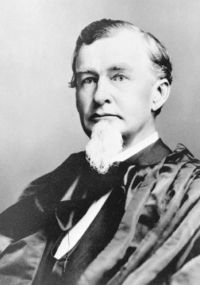
Howell Edmunds Jackson

Howell Edmunds Jackson

Summary

Portrait of Howell Edmunds Jackson Howell Edmunds Jackson Leggett v. Standard Oil Company…

It was well known that liquid glue had these coating and sticking qualities before it had ever been dried for commercial purposes, and to use it in its liquid state certainly did not embody the quality of invention. The only object or reason in drying the glue at all is to preserve it for transportation and commercial purposes, it being, in its liquid or jelly condition, susceptible to atmospheric influences, under the operation of which it is more liable to be spoiled than when dried.
Source: Wikisource

Portrait of Howell Edmunds Jackson Howell Edmunds Jackson Leggett v. Standard Oil Company…

It being thus clearly established that the use of liquid glue was well known to glue manufacturers and oil refiners, and had been actually applied in the very way and for the very purposes described by the complainant long before the date of his alleged invention, it is too clear for discussion that he could have no valid patent which would cover a process for using liquid glue for coating or sizing purposes as a new discovery or invention
Source: Wikisource

Portrait of Howell Edmunds Jackson Howell Edmunds Jackson Leggett v. Standard Oil Company…

Whatever advantages there may be in using liquid glue, or 'glue soup' before it is dried, over a similar use of remelted dried glue, were well known prior to the date of the complainant's application for the patent in question. It is shown by the testimony that in various general publications and trade journals published in Germany in the years 1869, 1870, and 1871, and circulated in this country, the advantages of using hot or liquid glue are set out, as well as the description of the manufacture of glue jelly by different parties and in different localities
Source: Wikisource

Get perspective with Kwize: daily news enlightened by great literature