Summary

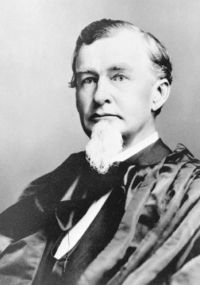
Portrait of Howell Edmunds Jackson Howell Edmunds Jackson United States v. Di Re — Opinion of the Court

How then could we say that the right to search a car without a warrant confers greater latitude to search occupants than a search by warrant would permit?
We see no ground for expanding the ruling in the Carroll case to justify this arrest and search as incident to the search of a car. We are not convinced that a person, by mere presence in a suspected car, loses immunities from search of his person to which he would otherwise be entitled.
Source: Wikisource

Portrait of Howell Edmunds Jackson Howell Edmunds Jackson United States v. Di Re — Opinion of the Court

In denouncing unlawful search by federal officers as a misdemeanor, Congress provided that it should not apply to one 'arresting or attempting to arrest any person committing or attempting to commit an offense in the presence of such officer, agent or employee, or who has committed, or who is suspected on reasonable grounds of having committed, a felony.' [12] Thus the legislative sources, while yielding some common provisions, also contain many inconsistencies. No act of Congress lays down a general federal rule for arrest without warrant for federal offenses.
Source: Wikisource

Portrait of Howell Edmunds Jackson Howell Edmunds Jackson United States v. Di Re — Opinion of the Court

We believe, however, that in absence of an applicable federal statute the law of the state where an arrest without warrant takes place determines its validity. By one of the earliest acts of Congress, the principle of which is still retained, the arrest by judicial process for a federal offense must be 'agreeably to the usual mode of process against offenders in such State.' [8] There is no reason to believe that state law is not an equally appropriate standard by which to test arrests without warrant, except in those cases where Congress has enacted a federal rule.
Source: Wikisource

Get perspective with Kwize: daily news enlightened by great literature