“ Bassett remembered that at the time, in lucid moments, he had likened himself to a wounded bull pursued by plains’ coyotes too cowardly to battle with him for the meat of him, yet certain of the inevitable end of him when they would be full gorged. As the bull’s horns and stamping hoofs kept off the coyotes, so his shot-gun kept off these Solomon Islanders, these twilight shades of bushmen of the island of Guadalcanal.Came the day of the grass lands. Abruptly, as if cloven by the sword of God in the hand of God, the jungle terminated. ”
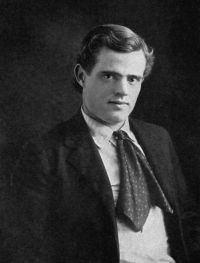
Jack London
Summary
Jack London’s The Red One, published posthumously in 1918 in The Cosmopolitan, follows scientist Bassett’s perilous journey to the jungle of Guadalcanal, where he becomes fixated on a massive red sphere of extraterrestrial origin revered by headhunting natives.
The story, shaped by Jungian psychology and echoing Conrad’s Heart of Darkness, delves into themes of fixation, the unknown, and humanity’s encounter with cosmic mysteries. Bassett’s ultimate sacrifice highlights the tale’s existential tension, merging science fiction with primal fear, and its cryptic allusions to alien relics foreshadow later speculative motifs.
Quotes from The Red One (Jack London)
“ Like a man in fever, waking to intervals of consciousness, so Old Tarwater awoke, cooked his moose-meat, and fed the fire; but more and more time he spent in his torpor, unaware of what was day-dream and what was sleep-dream in the content of his unconsciousness. And here, in the unforgetable crypts of man’s unwritten history, unthinkable and unrealizable, like passages of nightmare or impossible adventures of lunacy, he encountered the monsters created of man’s first morality that ever since have vexed him into the spinning of fantasies to elude them or do battle with them. ”
“ Having feasted, ready to depart with a hind-quarter of the pig in his hand, he deliberately fired the grass thatch of a house with his burning glass.But seared deepest of all in Bassett’s brain, was the dank and noisome jungle. It actually stank with evil, and it was always twilight. Rarely did a shaft of sunlight penetrate its matted roof a hundred feet overhead. And beneath that roof was an aerial ooze of vegetation, a monstrous, parasitic dripping of decadent life-forms that rooted in death and lived on death. ”
