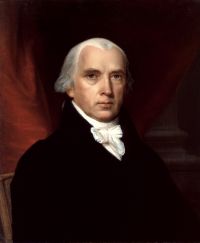
James Madison

James Madison

Summary

Portrait of James Madison James Madison,  Money — Essays, #4 (1791)

“ Every circumstance which has been found to accelerate the depreciation of our currency naturally resolves itself into these general principles. The spirit of monopoly hath affected it in no other way than by creating an artificial scarcity of commodities wanted for public use, the consequence of which has been an increase of their price, and of the necessary emissions. Now it is this increase of emissions which has been shewn to lengthen the supposed period of their redemption, and to foster suspicions of public credit. Monopolies destroy the natural relation between money and commodities ”
Source: Wikisource

Portrait of James Madison James Madison,  Money — Essays, #4 (1791)

“ In order to raise the value of our money, which depends on the time of its redemption, we have recourse to a measure which removes its redemption to a more distant day. Instead of paying off the capital to the public creditors, we give them an enormous interest to change the name of the bit of paper which expresses the sum due to them; and think it a piece of dexterity in finance, by emitting loan office certificates, to elude the necessity of emitting bills of credit. ”
Source: Wikisource

Portrait of James Madison James Madison,  Money — Essays, #4 (1791)

“ Suppose a country, totally unconnected with Europe or with any other country, to possess specie in the same proportion to circulating property that Europe does, prices there would correspond with those in Europe. Suppose that so much specie were thrown into circulation as to make the quantity exceed the proportion of Europe tenfold, without any change in commodities, or in the demand for them; as soon as such an augmentation had produced its effect, prices would rise tenfold, or, which is the same thing, money would be depreciated tenfold. ”
Source: Wikisource

Get perspective with Kwize: daily news enlightened by great literature