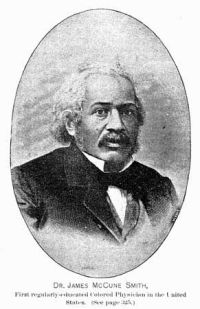
James McCune Smith

James McCune Smith

Summary

Portrait of James McCune Smith James McCune Smith Masterpieces of Negro Eloquence… (1914)

It was the glory and the warrantable boast of Toussaint that he had been the instrument of demonstrating that, even with the worst odds against them, this race is entirely capable of achieving liberty and of self-government. He did more: by abolishing caste he proved the artificial nature of such distinctions, and further demonstrated that even slavery cannot unfit men for the full exercise of all the functions which belong to free citizens.
Source: Wikisource

Portrait of James McCune Smith James McCune Smith Masterpieces of Negro Eloquence… (1914)

Born forty-seven years before the commencement of the revolt, he had reached the prime of manhood, a slave, with a soul uncontaminated by the degradation which surrounded him. Living in a state of society where worse than polygamy was actually urged, we find him at this period faithful to one wife—the wife of his youth—and the father of an interesting family. Linked with such tender ties, and enlightened with some degree of education, which his indulgent master, M. Bayou, had given him, he fulfilled, up to the moment of the revolt, the duties of a Christian man in slavery.
Source: Wikisource

Portrait of James McCune Smith James McCune Smith Masterpieces of Negro Eloquence… (1914)

The planters were obliged to employ their laborers on the footing of hired servants." "And under this system," says Lacroix, "the colony advanced, as if by enchantment towards its ancient splendor; cultivation was extended with such rapidity that every day made its progress more perceptible. All appeared to be happy, and regarded Toussaint as their guardian angel. In making a tour of the island, he was hailed by the blacks with universal joy, nor was he less a favorite of the whites."
Source: Wikisource

Get perspective with Kwize: daily news enlightened by great literature