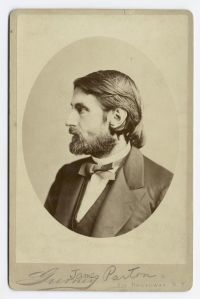
James Parton

James Parton

Summary

Portrait of James Parton James Parton Daughters of Genius (1887)

Browning became deeply interested in the fate of her new country, whose historical associations were so noble, but whose people had long seemed to be sunk in death. Though she had long before said of herself, "I, who am a woman, am not made for war," that in truth was one of the objects for which she lived. She was a battle-trumpet, sounding loud and long to wake the sleeping nation to newness of life. When the Revolution of 1848 stirred Italy from the Alps to Sicily she rejoiced in the fulfilment of her hopes.
Source: Wikisource

Portrait of James Parton James Parton Daughters of Genius (1887)

But Emily pined for Haworth and her beloved moor. Brussels was nothing to her; M. Héger only exasperated her, although she performed her tasks faithfully—finding, indeed, her only refuge from homesickness in labor. For his part, he recognized at once the exceptional talents of both his reserved, oddly dressed English pupils, but he considered Emily as the greater genius of the two; and indeed, her exercises were far superior to Charlotte's. His praise could not touch her, however; she cared only to do the work that must be done, and get home as quickly as possible.
Source: Wikisource

Portrait of James Parton James Parton Daughters of Genius (1887)

Miss Barrett, still physically weak, was utterly prostrated by grief and horror at the tragedy. She even blamed herself as having been the indirect cause of the loss. Unable to be moved from the sheltered house below the cliffs, she heard for a whole winter the sound of the waves like the moans of the dying. Her only diversion from these painful thoughts was study. Her physician could not approve such occupation in one hanging between death and life, and to prevent his remonstrances she had an edition of Plato bound like a novel.
Source: Wikisource

Get perspective with Kwize: daily news enlightened by great literature