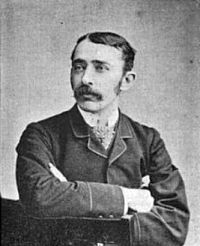
John Ambrose Fleming

John Ambrose Fleming

Summary

Portrait of John Ambrose Fleming John Ambrose Fleming 1911 Encyclopædia Britannica, Volume 6… (1911)

It is possible to form alloys having a resistivity as high as 100 microhms per cubic centimetre; but, on the other hand, the value of an alloy for electro-technical purposes is judged not merely by its resistivity, but also by the degree to which its resistivity varies with temperature, and by its capability of being easily drawn into fine wire of not very small tensile strength. Some pure metals when alloyed with a small proportion of another metal do not suffer much change in resistivity, but in other cases the resultant alloy has a much higher resistivity.
Source: Wikisource

Portrait of John Ambrose Fleming John Ambrose Fleming 1911 Encyclopædia Britannica, Volume 6… (1911)

It is customary in electro-technical work to consider the resistivity of the dielectric as the value it has after the electromotive force has been applied for one minute, the standard temperature being 75° F. This, however, is a purely conventional proceeding, and the number so obtained does not necessarily represent the true or ohmic resistance of the dielectric. If the electromotive force is increased, in the case of a large number of ordinary dielectrics the apparent resistance at the end of one minute’s electrification decreases as the electromotive force increases.
Source: Wikisource

Portrait of John Ambrose Fleming John Ambrose Fleming 1911 Encyclopædia Britannica, Volume 6… (1911)

With metallic alloys, however, rise of temperature does not always increase resistivity: it sometimes diminishes it, so that many alloys are known which have a maximum resistivity corresponding to a certain temperature, and at or near this point they vary very little in resistance with temperature. Such alloys have, therefore, a negative temperature-variation of resistance at and above fixed temperatures. Prominent amongst these metallic compounds are alloys of iron, manganese, nickel and copper, some of which were discovered by Edward Weston, in the United States.
Source: Wikisource

Get perspective with Kwize: daily news enlightened by great literature