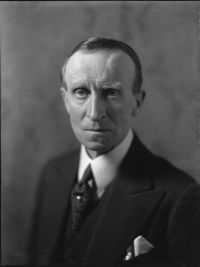
John Buchan

John Buchan

Summary

Portrait of John Buchan John Buchan The Battle of Jutland (1916)

From the moment of von Scheer's return to port the British fleet held the sea and is still holding it. The blockade which Germany thought to break was drawn tighter than ever. Her secondary aim was so to weaken the British Fleet that it should be more nearly on an equality with her own. Again she completely failed, and the margin of British superiority was in no way impaired. Lastly she hoped to isolate and destroy a British division. That, too, failed. The British Battle Cruiser fleet is to-day a living and effective force while the German Battle Cruiser fleet is only a shadow.
Source: Wikisource

Portrait of John Buchan John Buchan The Battle of Jutland (1916)

He appreciated the situation at once on sighting his enemy's lighter forces, then his battle cruisers, and finally his battle fleet. I can fully sympathise with his feelings when the evening mist and failing light robbed the fleet of that complete victory for which he had manœuvred, and for which the vessels in company with him had striven so hard." It is a tradition of the British Admiralty that it praises sparingly and only praises when the merit of an achievement is beyond question.
Source: Wikisource

Portrait of John Buchan John Buchan The Battle of Jutland (1916)

But if the Battle of Jutland had not the dramatic close of Trafalgar or the Nile, yet, in a true sense, it was decisive. It defeated, utterly defeated, the German plan. If it was not—as with two hours more daylight it would have been—a complete destruction of Germany's sea power, it was a complete demonstration of Britain's crushing superiority. Sir David Beatty faced great odds and great difficulties in the spirit of Hawke and Nelson.—"He once more showed," wrote the Commander-in-Chief, "his fine qualities of gallant leadership, firm determination, and correct strategical insight.
Source: Wikisource

Get perspective with Kwize: daily news enlightened by great literature