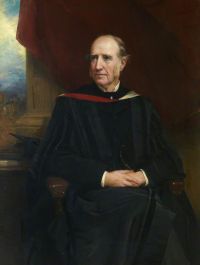
John Campbell Shairp

John Campbell Shairp

Summary

Portrait of John Campbell Shairp John Campbell Shairp On poetic interpretation of nature (1900)

Whenever any object of sense, or spectacle of the outer world, any truth of reason, or event of past history, any fact of human experience, any moral or spiritual reality; whenever, in short, any fact or object which the sense, or the intellect, or the soul, or the spirit of man can apprehend, comes home to one so as to touch him to the quick, to pierce him with a more than usual vividness and sense of reality, then is awakened that stirring of the imagination, that glow of emotion, in which Poetry is born. There is no truth cognizable by man which may not shape itself into Poetry.
Source: Gutenberg

Portrait of John Campbell Shairp John Campbell Shairp On poetic interpretation of nature (1900)

It is a true instinct when men are led to regard the beauty of the world that comes to them through the eye, and the moral light which shines from behind upon the soul, as coming from one centre, and leading upward to the thought of one Being who is above both. In this way all visible beauty becomes a hint and a foreshadowing of something more than itself. But if Nature is to be the symbol of something higher than itself, to convey intimations of Him from whom both Nature and the soul proceed, man must come to the spectacle with the thought of God already in his heart.
Source: Gutenberg

Portrait of John Campbell Shairp John Campbell Shairp On poetic interpretation of nature (1900)

Nature is wooing his spirit in manifold and mysterious ways, to elevate him with her vastness and sublimity, to gladden him with her beauty, to depress him with her bleakness, to restore him with her calm. This quick interchange of feeling between the world without and the world within, this vast range of sympathy, so subtle, so unceasing, so mysterious, is a fact as certain and as real as the flow of the tides or the motion of the earth. Yet, though truth it be, it is one which Science cannot recognize, and which she has left wholly to the poet.
Source: Gutenberg

Get perspective with Kwize: daily news enlightened by great literature