Summary

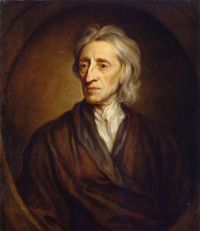
Portrait of John Locke John Locke An Essay Concerning Human Understanding…

For should the soul of a prince, carrying with it the consciousness of the prince’s past life, enter and inform the body of a cobbler, as soon as deserted by his own soul, every one sees he would be the same person with the prince, accountable only for the prince’s actions : but who would say it was the same man ? The body too goes to the making the man, and would, I guess, to everybody determine the man in this case, wherein the soul, with all its princely thoughts about it, would not make another man : but he would be the same cobbler to every one besides himself.
Source: Wikisource

Portrait of John Locke John Locke An Essay Concerning Human Understanding…

Self depends on consciousness, not on substance. Self is that conscious thinking thing, – whatever substance made up of, (whether spiritual or material, simple or compounded, it matters not) – which is sensible or conscious of pleasure and pain, capable of happiness or misery, and so is concerned for itself, as far as that consciousness extends. Thus every one finds that, whilst comprehended under that consciousness, the little finger is as much a part of himself as what is most so.
Source: Wikisource

Portrait of John Locke John Locke An Essay Concerning Human Understanding…

For, by the same reason that two particles of matter may be in one place, all bodies may be in one place : which, when it can be supposed, takes away the distinction of identity and diversity of one and more, and renders it ridiculous. But it being a contradiction that two or more should be one, identity and diversity are relations and ways of comparing well founded, and of use to the understanding.
Source: Wikisource

Get perspective with Kwize: daily news enlightened by great literature