Summary

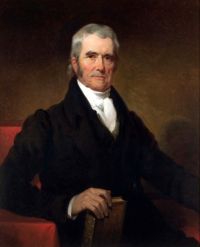
Portrait of John Marshall John Marshall Hughes v. Clarksville — Opinion of the Court

The plaintiff in error contends, that as the state of Virginia had conveyed all her territory north-west of the river Ohio to the United States, before any legal title was vested in the commissioners or trustees appointed by the act of 1783, the title at law was vested in the United States, and could pass only from them. That the reservation in favour of Clark's regiment, is not an exception of so much land from the deed of cession; but a stipulation that congress shall comply with the promise made by Virginia to that regiment. Consequently that the plaintiffs in ejectment had no legal title.
Source: Wikisource

Portrait of John Marshall John Marshall Hughes v. Clarksville — Opinion of the Court

They do not grow out of the estate, but are conferred by the words of the act. Had the title been vested in other persons, the same powers might have been conferred on, and exercised by the trustees of the town. No one of their powers depends on their possessing the legal title. They might lay off the town in lots and streets, sell and convey the lots, determine their boundaries, and settle rules and orders for the regular building thereon, although the mere title should reside in others.
Source: Wikisource

Portrait of John Marshall John Marshall Hughes v. Clarksville — Opinion of the Court

The legislature appears to have lost sight of the legal estate, and to have relied entirely on the powers given to the trustees and their successors for the accomplishment of their object. The powers are given to the trustees and their successors; the estate is not given to their successors. We do not think the grant of the powers draws after it the estate. If any use is to be made of the estate which cannot be effected by the employment of the powers, it still remains, we think, in the original grantees or their heirs.
Source: Wikisource

Get perspective with Kwize: daily news enlightened by great literature