Summary

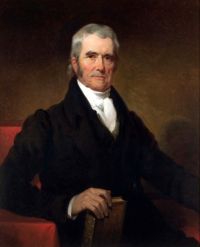
Portrait of John Marshall John Marshall Life and Fire Insurance Company of New York v…

It is not the demand of indemnity which gives a right to it, but there must be a substantial cause for apprehension in the marshal, to authorise his insisting on it. It is no cause for indemnity, when an officer is asked to sell a tract of land specifically subjected to the process; all that can be sold is the right of the party defendant, in the process; and if this right is not valid, the sale injures no one.
If there is a law of Louisiana which disqualifies a party who has become insolvent from appearing in court, it can have no operation in a court of the United States.
Source: Wikisource

Portrait of John Marshall John Marshall Life and Fire Insurance Company of New York v…

The contrary may rather be inferred from his readiness to grant a rule on the defendant, requiring him to show cause why judgment should not be rendered. In a case of such long standing, where it is more than possible the defendant might not be in court; where judgment is asked on a confession made by the agent of the plaintiffs, professing to be the attorney of the defendant; the judge may be excused for requiring that notice should be given to the defendant.
Source: Wikisource

Portrait of John Marshall John Marshall Life and Fire Insurance Company of New York v…

In the transaction of the 2d of May 1826, Christopher Adams stipulated to confess judgment on all the notes as they should become due, 'and in default of such confession, he constituted and appointed Henry Eckford, president of the Life and Fire Insurance Company, or his successor in office for the time being, his attorney in fact, and irrevocable, in his name and stead, to appear in court and cause judgment to be entered up,' &c.
Source: Wikisource

Get perspective with Kwize: daily news enlightened by great literature