Summary

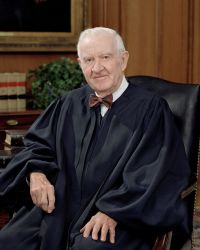
Portrait of John Paul Stevens John Paul Stevens Allen v. Wright — Dissenting Opinion

In Bob Jones, we clearly indicated that the Internal Revenue Code not only permits, but in fact requires, the denial of tax-exempt status to racially discriminatory private schools:
Few social or political issues in our history have been more vigorously debated and more extensively ventilated than the issue of racial discrimination, particularly in education.
Source: Wikisource

Portrait of John Paul Stevens John Paul Stevens Allen v. Wright — Dissenting Opinion

III Considerations of tax policy, economics, and pure logic all confirm the conclusion that respondents' injury in fact is fairly traceable to the Government's allegedly wrongful conduct. The Court therefore is forced to introduce the concept of "separation of powers" into its analysis. The Court writes that the separation of powers "explains why our cases preclude the conclusion" that respondents' injury is fairly traceable to the conduct they challenge.
Source: Wikisource

Portrait of John Paul Stevens John Paul Stevens Allen v. Wright — Dissenting Opinion

Although the form of the subsidy for segregated private schools involved in Gilmore and Norwood was different from the "cash grant" that flows from a tax exemption, the economic effect and causal connection between the subsidy and the impact on the complaining litigants was precisely the same in those cases as it is here. [p788]
This causation analysis is nothing more than a restatement of elementary economics: when something becomes more expensive, less of it will be purchased.
Source: Wikisource

Get perspective with Kwize: daily news enlightened by great literature