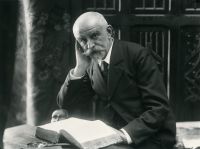
Joris-Karl Huysmans

Joris-Karl Huysmans

Summary

Portrait of Joris-Karl Huysmans Joris-Karl Huysmans Against the Grain — Chapter VIII (1926)

Yes, his object was attained; not one of them looked real; cloth, paper, porcelain, metal seemed to have been lent by man to Nature to enable her to create these monstrosities. When she had found herself incapable of copying human workmanship, she had been reduced to mimick the membranes of animals' insides, to borrow the vivid tints of their rotting flesh, the superb horrors of their gangrened skin.
"It is all a matter of syphilis," reflected Des Esseintes, his eyes attracted, riveted on the hideous marking of the Caladiums, lit up at that moment by a shaft of daylight.
Source: Wikisource

Portrait of Joris-Karl Huysmans Joris-Karl Huysmans Against the Grain — Chapter VIII (1926)

And lo! here it was reappearing, in its pristine splendour, on the bright-coloured petals of flowers!
"It is true," pursued Des Esseintes, going back to the starting point of his argument, "it is true that, for most of the time, Nature is by herself incapable of producing species so morbid and perverse; she supplies the raw material, the germ and the soil, the procreative womb and the elements of the plant, which mankind rears, models, paints, carves afterwards to suit his caprice."
Source: Wikisource

Portrait of Joris-Karl Huysmans Joris-Karl Huysmans Against the Grain — Chapter VIII (1926)

It resembled the gum-tree in its long leaves of a sombre, metallic green, but from the end of these leaves depended a green string, a sort of umbilical cord, carrying a greenish coloured urn, veined with purple, a sort of German pipe in porcelain, a strange kind of bird's nest, that swung quietly to and fro, exhibiting an interior carpeted with a hairy growth.
"That one is a veritable miracle," Des Esseintes murmured to himself.
Source: Wikisource

Get perspective with Kwize: daily news enlightened by great literature