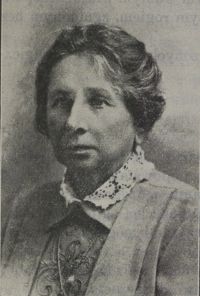
Josepha Kodis

Josepha Kodis

Summary

Portrait of Josepha Kodis Josepha Kodis,  Richard Avenarius (1896)

“ Therefore he came to form the opinion that the theory of knowledge was on the wrong path, and that it was just as capable of a positive development as any other of the sciences, if only it rejected its speculative and rationalistic methods. It had only to limit itself to the facts of knowledge, to investigate them in their relations to each other, their development corresponding to the individual environment, and modifications depending upon processes of the physiological states of the organism. ”
Source: Wikisource

Portrait of Josepha Kodis Josepha Kodis,  Richard Avenarius (1896)

“ Science possesses already some general notions of this purely experimental character, as, for example, the notion of energy in physics. But it is the tendency of the whole mass of human knowledge to become pure experience, in other words, to become in the highest degree adapted to the surrounding world. Humanity represents, in the whole, a kind of ultra-human organism, following the same rules of self-preservation, and consequently of adaptation as any individual organism.
This last statement brings us into the very heart of the theory of Avenarius.
”
Source: Wikisource

Portrait of Josepha Kodis Josepha Kodis,  Richard Avenarius (1896)

“ Therefore things and ideas should be the starting point of every philosophical investigation of the basis of our knowledge. All that we know consists only of things and ideas relating to them, and modifications of the latter more or less removed from the facts. Consequently everything in human knowledge is in some way an experience, but possessing different degrees of purity. The ideal knowledge is the pure experience which contains nothing but elements relative to the facts given by experience. ”
Source: Wikisource

Get perspective with Kwize: daily news enlightened by great literature