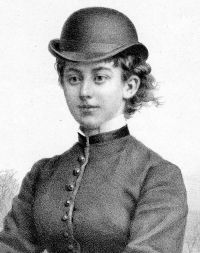
Lady Florence Dixie

Lady Florence Dixie

Summary

Portrait of Lady Florence Dixie Lady Florence Dixie Gloriana; or, the revolution of 1900 (1890)

He is standing on the steps of Montragee House, clad in his White Guard’s uniform. A long line of the White Regiment keep the road clear to Westminster. The crowd is dense all round. Nothing but a sea of faces can be seen, and the cheers of the people have grown into a hoarse, continuous roar. Thousands and thousands of women are amongst that crowd, women, with hearts full of love and devotion for their hero; women who would account it a happiness to die for him at any hour; women who are strong in their gratitude for what he has done, and is trying to do for them.
Source: Gutenberg

Portrait of Lady Florence Dixie Lady Florence Dixie Gloriana; or, the revolution of 1900 (1890)

I have but one answer to your hateful proposal, and that is, no!”
“Have you weighed well in your mind the fate that awaits you, Hector D’Estrange, if you persist in this refusal?” asks Lord Westray threateningly.
“My name is Gloria de Lara, my lord, not Hector D’Estrange, as I think you know full well. The fate that awaits me I fully realise. I am condemned to death for a murder never committed; I am to die that your vile vengeance on my beloved mother may be fully wreaked. Do your worst. I do not fear death; and my mother will bear the blow as bravely and as nobly as she has borne others.”
Source: Gutenberg

Portrait of Lady Florence Dixie Lady Florence Dixie Gloriana; or, the revolution of 1900 (1890)

The world has courted his love, but its wiles have not awoke it. Often, when in loving commune with his friend Hector D’Estrange, the thought would flash through the young duke’s mind, that if Hector had been a woman, the great love of which he felt himself capable, would have gone out to her absolutely and without reserve. What was the subtle power that had attracted him to Hector D’Estrange, which had made him pause on the verge of pleasure’s precipice, and, casting to the winds his hitherto selfish existence, had made him body and soul the devoted adherent of the young reformer?
Source: Gutenberg

Get perspective with Kwize: daily news enlightened by great literature