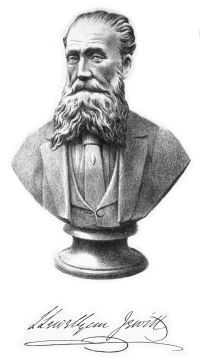
Llewellynn Frederick William Jewitt

Llewellynn Frederick William Jewitt

Summary

Portrait of Llewellynn Frederick William Jewitt Llewellynn Frederick William Jewitt Grave-mounds and Their Contents

It has long appeared to me that a general résumé of the almost endless store of knowledge presented by the very varied relics of the grave-mounds of the three great divisions of our history—the Celtic, the Romano-British, and the Anglo-Saxon—kept distinct from the histories of those peoples, and from extraneous matters, and treating them more in a general than in an ethnological manner, could not fail to be a useful addition to our archæological literature, and would prove of great value and convenience to the general reader, as well as to the antiquary and the historian.
Source: Gutenberg

Portrait of Llewellynn Frederick William Jewitt Llewellynn Frederick William Jewitt Grave-mounds and Their Contents

Thus the relics which they contain have come down to us intact, and even now tell their wondrous tale, in a language of their own, of ages and of races of beings long since passed away. A single implement of stone or of flint; a weapon or an ornament of bronze, of iron, or of bone; a bead of jet or of glass; an urn, or even a fragment of pottery; or any one 2 of the infinity of other relics which are exhumed, no matter to what period they belong, or from what locality they may have come; one and all tell their own tale, and supply new links to our ever-extending chain of knowledge.
Source: Gutenberg

Portrait of Llewellynn Frederick William Jewitt Llewellynn Frederick William Jewitt Grave-mounds and Their Contents

Wherever the burning has taken place there is evidence of an immense amount of heat being used; the soil, for some distance below the surface, being in many places burned to a redness almost like brick. Remains of charcoal, the refuse of the funeral pyre, are very abundant, and in some instances I have found the lead ore, which occurs in veins in the limestone formation of Derbyshire, so completely smelted with the heat that it has run into the crevices among the soil and loose stones, and looks, when dug out, precisely like straggling roots of trees.
Source: Gutenberg

Get perspective with Kwize: daily news enlightened by great literature