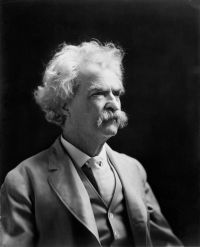
Mark Twain

Mark Twain

Summary

Portrait of Mark Twain Mark Twain The American Vandal Abroad (1868)

The renowned Parthenon towered above us, and about us were the wreck of what were once the snowy marble Temples of Hercules and Minerva, and another whose name I have forgotten. Most of the Parthenon's grand columns are still standing, but the roof is gone.
As we wandered down the marble-paved length of this mighty temple, the scene was strangely impressive. Here and there in lavish profusion were gleaming white statues of men and women, propped against blocks of marble, some of them armless, some without legs, others headless, but all looking mournful and sentient and startlingly human!
Source: Wikisource

Portrait of Mark Twain Mark Twain The American Vandal Abroad (1868)

He is bound for Venice, the oldest and the proudest and the princeliest republic that ever graced the earth. We put on a good many airs with our little infant of a Republic of a century's growth, but we grow modest when we stand before this gray, old imperial city that used to laugh the armies and navies of half the world to scorn, and was a haughty, invincible, magnificent Republic for fourteen hundred years!
Source: Wikisource

Portrait of Mark Twain Mark Twain The American Vandal Abroad (1868)

They rose up and confronted the midnight intruder on every side; they stared at him with stony eyes from unlooked-for nooks and recesses; they peered at him over fragmentary heaps far down the desolate corridors; they barred his way in the midst of the broad forum, and solemnly pointed with handless arms the way from the sacred fane; and through the roofless temple the moon looked down and banded the floor and darkened the scattered fragments and broken statues with the slanting shadows of the columns!
Source: Wikisource

Get perspective with Kwize: daily news enlightened by great literature