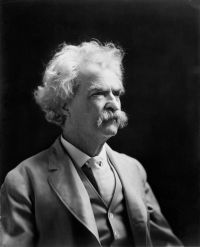
Mark Twain

Mark Twain

Summary

Portrait of Mark Twain Mark Twain The Prince and the Pauper (1882, c1881)

But Tom Canty was not sorry; for this loyal uproar was sweeter music to him than any poetry, no matter what its quality might be. Whithersoever Tom turned his happy young face, the people recognized the exactness of his effigy's likeness to himself, the flesh and blood counterpart; and new whirlwinds of applause burst forth.
The great pageant moved on, and still on, under one triumphal arch after another, and past a bewildering succession of spectacular and symbolical tableaux, each of which typified and exalted some virtue, or talent, or merit, of the little king's.
Source: Wikisource

Portrait of Mark Twain Mark Twain The Prince and the Pauper (1882, c1881)

He said—
"GO ON—TELL MY THY STORY.""I think thou callest thyself Miles Hendon, if I heard thee aright?"
"Yes, sire," Miles replied; then observed to himself, "If I must humor the poor lad's madness, I must sire him, I must majesty him, I must not go by halves, I must stick at nothing that belongeth to the part I play, else shall I play it ill and work evil to this charitable and kindly cause."
The king warmed his heart with a second glass of wine, and said—"I would know thee—tell me thy story. Thou hast a gallant way with thee, and a noble—art nobly born?"
Source: Wikisource

Portrait of Mark Twain Mark Twain The Prince and the Pauper (1882, c1881)

I am but young to die, and thou canst save me with one little word. Oh speak it, sir!"
"Die? Talk not so, sweet prince—peace, peace, to thy troubled heart—thou shalt not die!"
Tom dropped upon his knees with a glad cry,—
"God requite thy mercy, oh my King, and save thee long to bless thy land!" Then springing up, he turned a joyful face toward the two lords in waiting, and exclaimed, "Thou heard'st it! I am not to die: the King hath said it!"
Source: Wikisource

Get perspective with Kwize: daily news enlightened by great literature