Summary

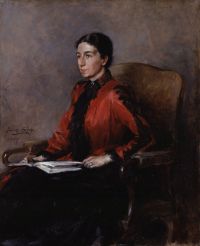
Portrait of Mary Augusta Ward Mary Augusta Ward 1911 Encyclopædia Britannica, Volume 17… (1911)

According to Landmann, Shakespeare’s Love’s Labour Lost is a caricature of the Italianate and pedantic fashions of the day, not of the peculiar style of Euphues. The only certain allusion in Shakespeare to the characteristics of Lyly’s famous book is to be found in Henry IV., where Falstaff, playing the part of the king, says to Prince Hal, “Harry, I do not only marvel where thou spendest thy time, but also how thou art accompanied; for, though the camomile the more it is trodden on the faster it grows, yet youth the more it is wasted the sooner it wears.”
Source: Wikisource

Portrait of Mary Augusta Ward Mary Augusta Ward 1911 Encyclopædia Britannica, Volume 17… (1911)

The plot of Euphues is extremely simple. The hero, whose name may very possibly have been suggested by a passage in Ascham’s Schoolmaster, is introduced to us as still in bondage to the follies of youth, “preferring fancy before friends, and this present humour before honour to come.” His travels bring him to Naples, where he falls in love with Lucilla, the governor’s light-minded daughter. Lucilla is already pledged to Euphues’s friend Philautus, but Euphues’s passion betrays his friendship, and the old lover finds himself thrown over by both friend and mistress.
Source: Wikisource

Portrait of Mary Augusta Ward Mary Augusta Ward 1911 Encyclopædia Britannica, Volume 17… (1911)

It was not the matter of Euphues, however, so much as the style which made it famous (see Euphuism) . The source of Lyly’s peculiar style has been traced by Dr Landmann (Der Euphuismus, sein Wesen, seine Quelle, seine Geschichte, &c. Giessen, 1881) to the influence of Don Antonio de Guevara, whose Libro Aureo de Marco Aurelio (1529) —a sort of historical romance based upon Plutarch and upon Marcus Aurelius’s Meditations, the object of which was to produce a “mirror for princes,” of the kind so popular throughout the Renaissance—became almost immediately popular in England.
Source: Wikisource

Get perspective with Kwize: daily news enlightened by great literature